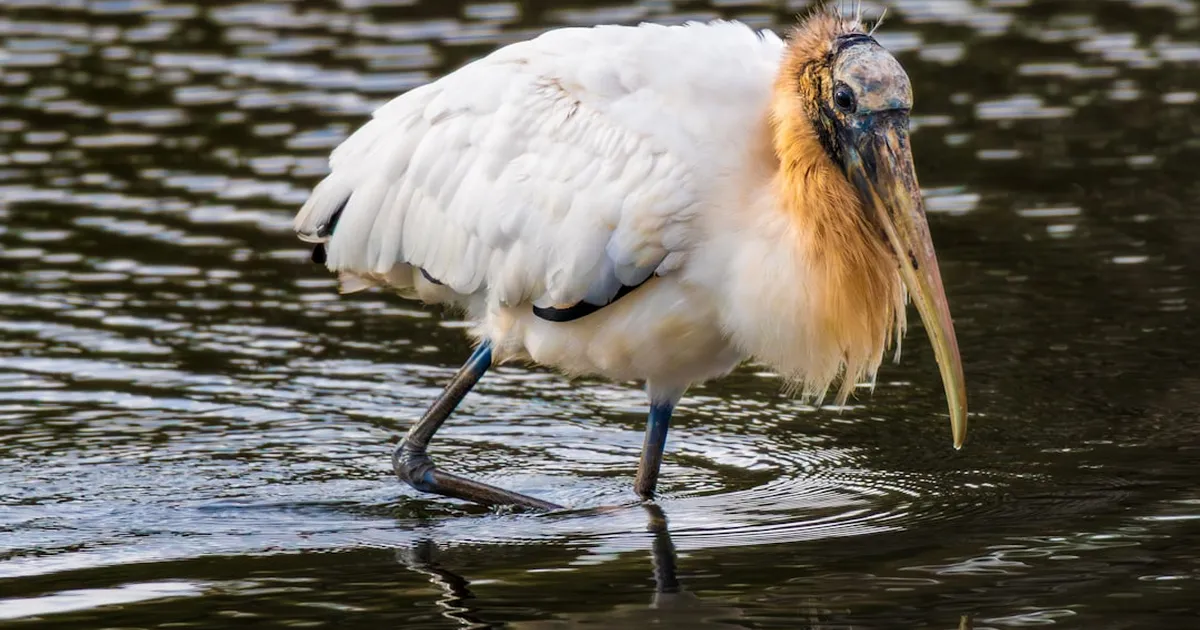
In 1984, the American Wood Stork was on the brink of regional extinction. In March 2026, the U.S. Fish and Wildlife Service (FWS) officially removed it from the federal endangered species list: the population has more than doubled since listing, and the bird has colonized habitats that did not even exist in the 1930s.
From 6,000 to 14,000 Breeding Pairs
In the 1930s, roughly 20,000 Wood Stork pairs still nested in the United States, almost exclusively in the wetlands of southeastern Florida. By 1984, when the FWS listed the species under the Endangered Species Act, numbers had collapsed by more than 75 percent to an estimated 6,040 breeding pairs. The primary cause was the large-scale loss of wetlands: between the 1950s and 1970s, the Everglades and surrounding marshes were drained through canal construction to make way for agriculture and urban expansion. Wood Storks depend on shallow, slowly receding waters where fish become densely concentrated as water levels drop. When that hydrology is disrupted, the birds cannot feed their chicks.
Three Decades of Targeted Recovery
The delisting took effect on March 9, 2026. Today, between 10,000 and 14,000 breeding pairs nest at around 100 colony sites, more than three times as many colonies as at the time of original listing. FWS Director Brian Nesvik said at the announcement: "The recovery of the Wood Stork is a true conservation success story, made possible by the dedication of many partners."
Three factors drove the turnaround: federally funded wetland restoration, improved water management in the Everglades through the Comprehensive Everglades Restoration Plan, and habitat protection programs in Georgia and South Carolina. State-level conservation laws also shielded colony sites from direct disturbance and development.
A Bird That Moved Into Wastewater Plants
What makes the Wood Stork's comeback especially striking is its geographic expansion. Once confined to southeastern Florida, the species now breeds from Mississippi to North Carolina, with established colonies in Alabama, Georgia and South Carolina. More remarkably, the birds have colonized entirely new habitat types that did not figure in the original recovery plan: salt marshes, abandoned rice fields, floodplain forests, and artificial wetlands including stormwater retention basins and wastewater treatment plants. This adaptability to human-made water bodies significantly accelerated recovery.
The 1973 Endangered Species Act is the legal backbone of this success. The law mandates protection for listed species and their habitats, and allows federal agencies to block construction projects in critical areas. Roughly 60 percent of all species ever listed under the ESA have stabilized or reversed their decline. Other recent delisting successes include the Bald Eagle in 2007 and the Brown Pelican in 2009.
A Contested Decision
Not all conservationists share the federal agency's confidence. Will Harlan of the Center for Biological Diversity called the delisting "a truly dangerous, premature decision," pointing out that the Wood Stork has fully met only one of three central goals set in its official Recovery Plan. Fledgling survival rates in southwest Florida remain below target and that regional subpopulation has not sufficiently recovered. Harlan also warned that the decision comes precisely as federal wetland protections are being rolled back under current regulatory policy.
The FWS counters that the overall population sits well above the threshold that triggers extinction concern, and that state-level conservation laws in Florida, Georgia and South Carolina continue to protect colony sites independently of the federal listing.
Ten Years of Monitoring as a Safety Net
The FWS has announced a ten-year post-delisting monitoring program. Population trends will be tracked annually and if breeding pair numbers drop sharply, the agency has reserved the right to relist the species. In the Everglades, where the most important nesting sites are concentrated, federal water management projects are ongoing and expected to benefit the Wood Stork for decades to come.
The Wood Stork's recovery demonstrates what sustained conservation law and targeted habitat restoration can achieve over four decades. Whether the legal framework that made this possible will remain intact amid broader deregulation trends is the question that conservationists are now watching closely.