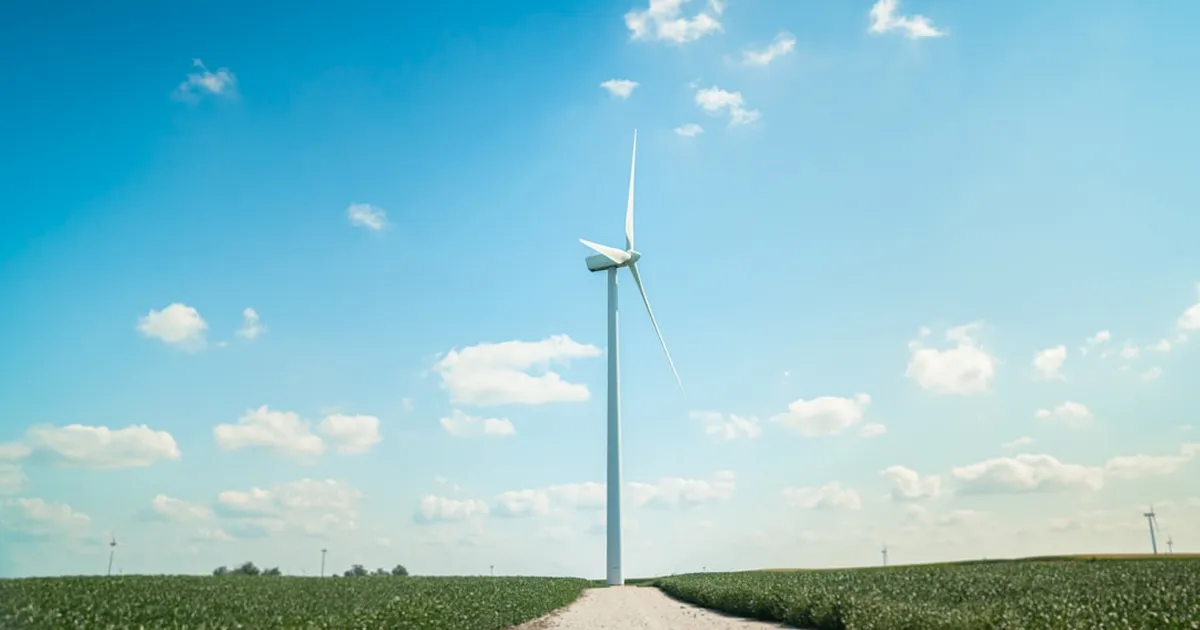
A date that will stand in the history of Germany's energy transition: in 2025, wind and photovoltaic together generated more electricity than any other source. The Fraunhofer Institute for Solar Energy Systems (ISE) reported in early 2026 that wind was the largest net power producer at 132 terawatt-hours (TWh), followed by solar at 87 TWh. Photovoltaic thus overtook lignite for the first time in the history of German electricity supply.
What the Numbers Mean
Wind produced a total of 132 TWh in 2025: roughly 106 TWh from onshore turbines and a further 26 TWh from offshore parks in the North and Baltic Seas. Photovoltaic grew by 21 percent year on year and fed around 71 TWh into the public grid. A further 16.9 TWh was consumed directly by operators and does not appear in official net statistics. In total, renewables covered 55.9 percent of public net generation in Germany.
For comparison: in 2015 the renewables share stood at around 30 percent. In ten years it has nearly doubled. Lignite, the backbone of German power supply for decades, has slipped to third place.
How Germany Got Here
At the end of 2025, 5.7 million photovoltaic systems with a total installed capacity of 117 gigawatts were in operation in Germany, registered with the Federal Network Agency. In 2025 alone, 16.4 gigawatts of new solar came online. Among these were nearly 430,000 so-called plug-in solar systems, balcony power plants, now operated by over 1.2 million households. Their share of total output is modest at 3.2 percent, but their cultural signal is not: the energy transition has reached German balconies too.
The pace of onshore wind expansion also accelerated: 4.6 gigawatts of new capacity were added in 2025, significantly more than the 2.6 gigawatts of the previous year. The Federal Network Agency read this as a clear signal that planning-acceleration laws of recent years are starting to bite.
European Context
Germany is not unique. Fraunhofer ISE pointed out that across the entire EU, photovoltaic overtook coal power generation in 2025 for the first time. Countries such as Spain, the Netherlands and Portugal show even higher renewables shares. The EU-wide trend shows: transforming the electricity system is no longer a German experiment, it is a European reality.
Unresolved Issues
Despite the milestone, the energy transition remains ongoing work. The fossil share stagnated in 2025 rather than falling: the decline of lignite was largely offset by rising gas generation. The federal government's target of lifting renewables to at least 80 percent by 2030 requires an expansion to 115 gigawatts of onshore wind and 215 gigawatts of solar. On solar, Germany is on track. On wind, not quite. But for the first time in decades the curves are moving in the same direction.