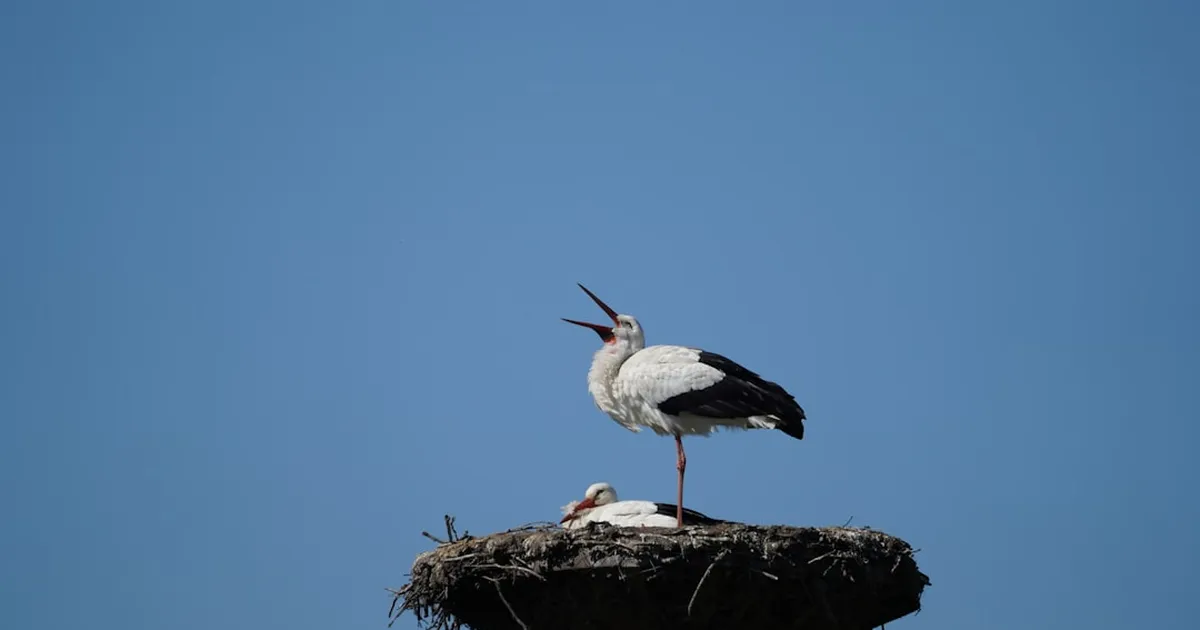
In October 2026, white storks will be reintroduced to London for the first time in more than 600 years. The city will release six birds into Eastbrookend Country Park in the borough of Dagenham, funded by 500,000 pounds from the Mayor's Green Roots Fund. Beavers will follow in March 2027. The project is part of urban rewilding, the deliberate return of native wildlife not to the city's edges but to the city itself.
What kept the stork out of Britain for 600 years
The last documented breeding record of white storks in Britain dates to Edinburgh in 1416, at St Giles' Cathedral. The reasons for their disappearance lay in landscape change: the wet meadows that storks need for foraging were drained and converted to farmland. Centuries of hunting compounded the loss. Ciconia ciconia, with a wingspan of up to 215 centimetres one of Europe's most distinctive large birds, survived on the continent while Britain went without for six centuries.
In Europe, populations have grown steadily over recent decades. BirdLife International estimates the European population at 502,000 to 563,000 mature individuals, an increase of roughly 20 percent compared with earlier estimates, driven mainly by conservation measures in Spain and Eastern Europe.
Who is paying and why Dagenham
The London city administration is funding the project with 500,000 pounds from the Mayor's Green Roots Fund. The London Wildlife Trust is coordinating the effort: a purpose-built aviary in Eastbrookend Country Park will serve as an acclimatisation station before the birds gain access to the surrounding lakes and wetlands. The six storks are intended to settle in the park and ideally form a breeding pair.
The Dagenham site in east London is no accident. The area around Eastbrookend Country Park is one of the few parts of London with sufficient unsealed wetland to serve as foraging habitat for storks. The timing follows an earlier project: in 2023, beavers were reintroduced to Greenford in the borough of Ealing after 400 years of absence. Further beavers are to follow in March 2027.
What the Knepp project tells us about prospects for success
The first modern white stork reintroduction in Britain began in 2019 at the Knepp Estate in Sussex. In 2020, storks bred successfully in Britain for the first time in 600 years. In 2025, the White Stork Project at Knepp recorded 45 fledged young from 18 active nests. Storks are breeding under British conditions. The London project takes this a step further: it transfers the concept from rural Sussex into a metropolis of more than nine million people.
Urban rewilding does not follow a romantic vision of nature but an ecological argument: even heavily settled urban spaces can become habitable for wildlife when habitat is deliberately restored. The decisive condition for storks is wetland within reach. Where that exists, Ciconia ciconia settles, as the Knepp data show.
In comparison: lammergeiers, beavers and the logic of reintroduction
The London project is part of a long line of European reintroductions. The lammergeier went extinct in the Alps in 1913 and was reintroduced in a coordinated European programme from 1986. Today more than 300 lammergeiers live in the Alps. The European beaver disappeared from large parts of Europe in the 19th century and now numbers over 40,000 animals in Germany following targeted reintroduction. These projects took place in protected areas or thinly populated landscapes. The London stork project explicitly does not treat urban density as a disqualifying factor, which makes it unusual among these examples.
Berlin, Rotterdam, Vienna: which cities are following
London is not alone. Berlin has run beaver projects in urban waterways since 2020. Bristol has established pollinator corridors to give bees routes through the city. Rotterdam and Amsterdam have begun wetland restoration along urban waterways targeting the return of waterfowl and amphibians. The European network Rewilding Europe names Vienna, Stockholm and Zurich as the next cities examining similar projects tailored to local wildlife species.
What all these projects share: they show that which wildlife lives in a city is a political and planning decision, not a given. London has made that decision for the white stork. Whether the storks will stay will be seen in the autumn of 2026.