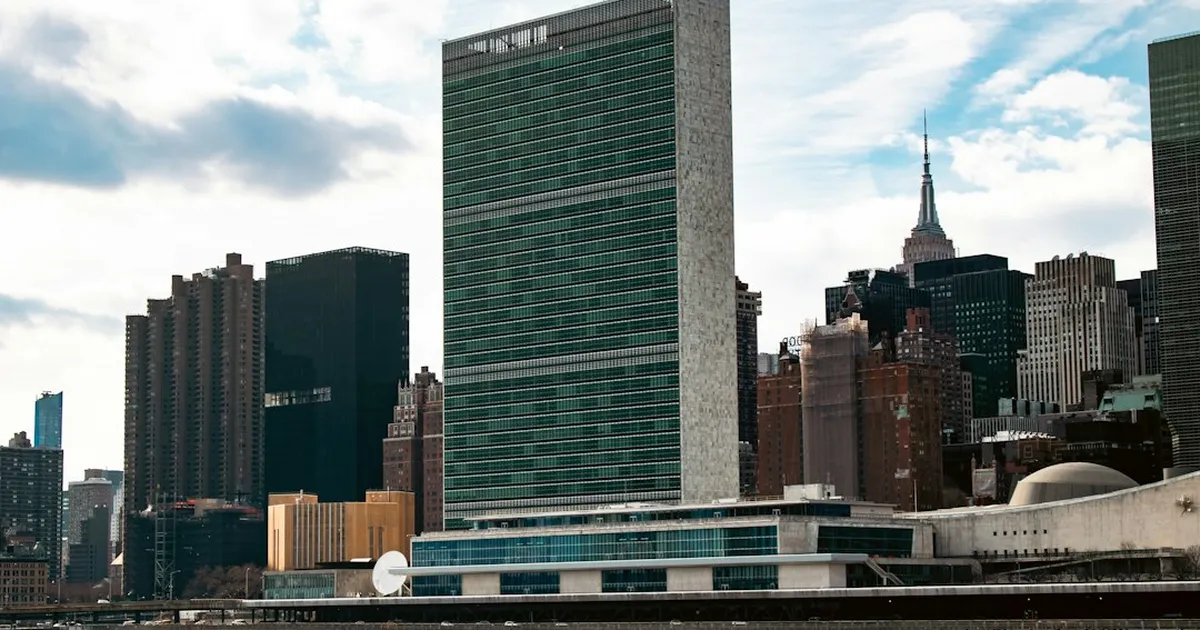
At a high-level meeting of the 81st UN General Assembly, heads of state and government adopted the UN Declaration on Sea Level Rise by consensus on Thursday, September 24, 2026. According to the World Meteorological Organization, adoption occurred by acclamation following a lengthy and intense negotiation process. According to a Christian Science Monitor report, all 193 UN member states approved a joint declaration on sea level rise. The four-page declaration calls for stronger measures to protect vulnerable coastal communities.
Mandate from 2024
The General Assembly had issued the mandate for the meeting on August 1, 2024, through its Resolution 78/558, calling for a high-level meeting and a consensus-based, action-oriented declaration. The 2026 meeting was preceded by a high-level meeting on September 25, 2024, where the General Assembly elevated sea level rise as a matter of global interest and called for political leadership and coordinated global action. The UN International Law Commission had been investigating the issue since 2019 and completed its work on maritime law, continued statehood, and protection of affected persons in 2025.
What the declaration establishes for threatened states
At its core, the text affirms a presumption favoring continued statehood and underscores the continuity of sovereignty, sovereign rights, and UN membership of affected countries in accordance with international law. It recalls that the disappearance of part of an existing state does not necessarily mean loss of its statehood. Under UNCLOS, the UN Convention on the Law of the Sea, maritime zones established by states can be maintained despite physical changes from sea level rise, without denying them the right to update these later. In practical terms, according to the Christian Science Monitor, countries can continue as sovereign political entities even if their territory later disappears, and can continue to control their original maritime boundary and exclusive rights for fishing or energy. The official declaration text affirms a presumption favoring continued statehood in accordance with international law; preservation of maritime zones explicitly refers to zones established under UNCLOS. According to a JURIST report, questions remain open regarding resettlement, nationality, compensation, and cross-border displacement when populations are forced to migrate abroad.
Financing falls short of expert assessments
The declaration simultaneously calls for expanded access to financing and acknowledges a commitment by developed countries to co-finance coastal protection measures. As Grist reports, the declaration alone does not increase available funds for nations like the Marshall Islands: wealthy countries currently provide roughly $130 billion annually in grants and concessional loans for clean energy and adaptation, substantially less than experts consider necessary. The world agreed to provide $300 billion annually in climate aid by 2035. Much of that comes as loans that many island states can barely bear, as evidenced by the billions in debt the Bahamas accumulated after Hurricane Dorian in 2019. AOSIS chair and Palau President Surangel Whipps Jr. stated that the declaration cannot stop sea level rise itself, only climate action can; every fraction of a degree of warming locks in further rise. UN Secretary-General António Guterres called at the meeting for global emissions to peak immediately and fall 60 percent by 2035, while adaptation financing must triple.
Comparison: Over three decades of diplomatic groundwork
The declaration builds on decades of work by small island states: they first sounded the alarm in 1989 with the Malé Declaration on global warming and sea level rise. Leadership of the Pacific Islands Forum adopted separate declarations on maritime zones and statehood in 2021 and 2023. The Alliance of Small Island States (AOSIS) adopted corresponding declarations in 2021 and 2024. The International Court of Justice supported this position in July 2025 with an opinion stating that a state does not necessarily lose its statehood if one of the elements traditionally associated with it disappears. The International Tribunal for the Law of the Sea had already found in its 2024 opinion that anthropogenic greenhouse gas emissions constitute marine pollution under UNCLOS and that states are obligated to protect the marine environment from consequences such as sea level rise.
The scale of the threat is measurably growing: the global mean sea level rise rate has doubled from 2.1 to 4.7 millimeters per year, according to the General Assembly concept note. This doubling occurred between the measurement periods 1993 to 2002 and 2015 to 2024. Today, approximately 770 million people live less than five meters above high-water line, Guterres said. Globally, approximately 900 million people live in low-lying coastal zones. This number is expected to approach one billion by 2050.
Implementation of demands for adaptation, financial support, and stronger climate action depends on individual countries and international institutions. The General Assembly has committed to determining by its 83rd session the scope and modalities of another high-level meeting to take place before the end of the 84th session. Bahamas Prime Minister Philip Davis put expectations into perspective: the declaration will hopefully increase the flow of concrete measures, even though his country is already losing land to the water.