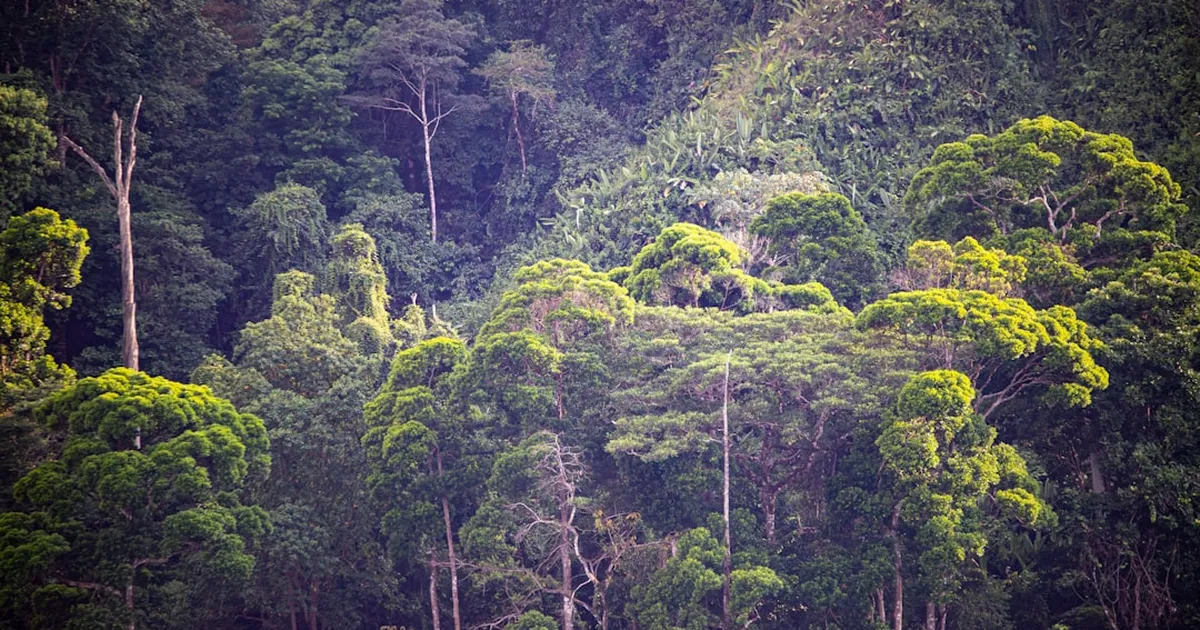
The world lost 4.3 million hectares of tropical primary forest in 2025, an area the size of Denmark. That is a troubling figure, but it is also 36 percent less than in the record year 2024. The decline comes almost entirely from one country: Brazil, where President Lula revived the federal anti-deforestation plan and enforcement agencies acted with renewed resolve. Elsewhere, above all in Bolivia and the Democratic Republic of Congo, 2025 was the worst or second-worst year on record.
How Brazil reversed the trend
The Brazilian Amazon is the world's largest tropical rainforest and was for years the world's largest single source of deforestation. At its peak in 2004, 27,772 square kilometres of forest were destroyed annually in the Brazilian Amazon. The federal anti-deforestation plan PPCDAm, combining satellite monitoring, law enforcement and economic incentives, drove deforestation down by 84 percent by 2012. When Bolsonaro effectively suspended PPCDAm, deforestation alerts in 2022 hit the highest level since records began.
After Lula's election victory, PPCDAm was relaunched in 2023. The results are measurable: the environmental agency IBAMA imposed 81 percent more enforcement actions and 63 percent higher fines between 2023 and 2025 compared with the Bolsonaro years of 2020 to 2022. In 2025, Brazil lost 1.63 million hectares of primary forest to non-fire causes, 41 percent less than the 2.83 million hectares in 2024. According to Global Forest Watch data, it was the lowest figure Brazil has ever recorded.
Fires are a separate and growing problem. Globally, 25.5 million hectares of tree cover were lost in 2025, of which 42 percent was destroyed by fire. That is almost six times the non-fire losses in tropical primary forest. For the third consecutive year, Brazil, Canada and Bolivia were among the countries most severely affected by wildfires.
The counter-picture: Bolivia and the Congo
While Brazil moves forward, other countries show how far from self-evident that progress is. Bolivia lost a total of 620,630 hectares of primary forest in 2025, its second-worst year on record. The Democratic Republic of Congo recorded a new high for non-fire primary forest loss, driven primarily by smallholder subsistence agriculture where global trade agreements offer few policy levers. Indonesia recorded a 14 percent increase to 296,000 hectares, while the NGO Auriga Nusantara, using a broader forest definition, measures an increase of 66 percent.
The World Resources Institute, which analyses Global Forest Watch data, notes: the global deforestation rate still stands 70 percent above the level needed to meet the goals of the Glasgow Declaration of 2021, under which more than 140 countries pledged to halt deforestation by 2030.
In comparison: Costa Rica shows what sustained success looks like
Costa Rica is the only tropical country that has achieved a full and lasting reversal of deforestation. In the 1980s, forests covered just 21 percent of the country, the lowest figure ever recorded. Today the figure is back to around 60 percent. The central lever was the 1996 Payments for Ecosystem Services (PES) programme, which gives landowners direct payments for maintaining forests, financed by a fuel tax. Since the programme began, World Bank data show that over 524 million dollars have been paid to forest owners and more than one million hectares of forest secured.
Brazil had achieved a comparable feat between 2004 and 2012 under the first PPCDAm plan: 84 percent less deforestation in eight years. The difference from Costa Rica lies in durability. What is introduced politically can be dismantled politically, as the Bolsonaro years demonstrated. The current decline is a success that depends on political continuity.
Why Brazil's success is not enough on its own
Brazil's 2025 decline is real, but it changes the global picture only in part. The Glasgow targets for 2030 require not only that Brazil holds course, but that countries such as Bolivia, the Democratic Republic of Congo and Indonesia make comparable shifts. For the DRC, the political context is absent: where deforestation is driven by subsistence farming in an extremely poor population, the Brazilian instruments of stronger commercial enforcement hardly apply. The WRI estimates that without a substantial increase in international financing for forest-rich developing countries, the Glasgow Declaration will remain a statement of intent.
The 36 percent fewer losses in 2025 is nonetheless a signal that is rarely heard in the deforestation debate: that political decisions produce measurable results when they are consistently enforced. Brazil's return to PPCDAm is the clearest evidence of this decade.