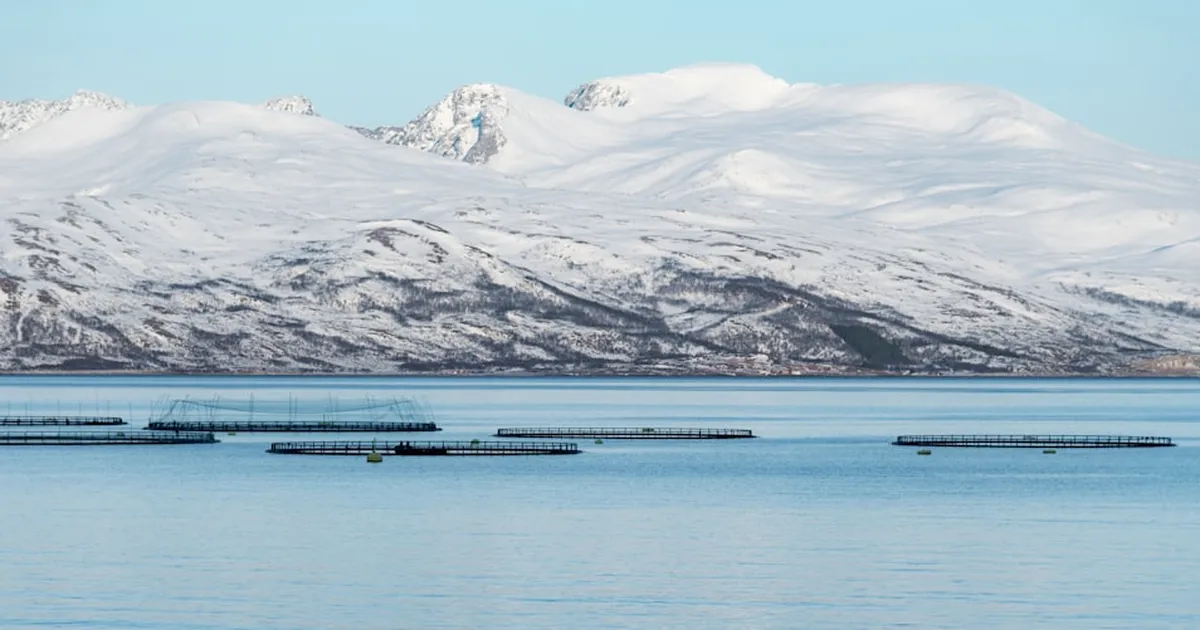
Two billion people worldwide lack safe access to drinking water. Desalination is considered one of the key technologies to address this, but it repeatedly stumbles over costs, energy demand, and the footprint required at coastlines. Norwegian startup Flocean has now commissioned the world's first commercial subsea desalination plant at Mongstad, Norway. According to the company, it consumes 50 percent less energy than comparable land-based plants.
How It Works
Conventional desalination plants sit at the coast and pump seawater through membranes that filter out salt. This reverse osmosis process requires high pressure and therefore a great deal of electricity. Flocean's approach is different: the plant is lowered to depths of 300 to 600 metres, where the natural water pressure of the ocean already reaches between 30 and 60 bar. This is precisely the pressure that a land-based reverse osmosis plant must generate artificially. At depth, that effort is largely eliminated. Flocean reports an energy saving of around 50 percent and a capital cost advantage of approximately seven times compared with conventional land installations.
The first commercial plant at Mongstad, roughly 60 kilometres north of Bergen, produces 1,000 cubic metres of drinking water per day. That is modest compared with large desalination plants in the Middle East, which deliver several hundred thousand cubic metres daily. Flocean states that the technology is modularly scalable to 50,000 cubic metres per day. The company itself describes the current plant as a proof of concept for commercial operation.
Why Now
Flocean was founded in 2018 and tested the technology at smaller scale, also at Mongstad. According to the company, the plant logged more than a year of test operations there. In November 2025, Xylem, a US water technology company with annual revenues of around seven billion dollars, joined as a strategic investor. TIME Magazine included Flocean's technology in its list of Best Inventions 2025.
The timing fits a global dynamic: the number of people living in water-stressed regions has doubled since 2000. The 2023 UN Water Conference listed desalination as one of three priority technologies for closing the global water gap. At the same time, falling costs for renewable energy are making energy-intensive processes such as water desalination cheaper.
Compared with Other Water Technologies
Desalination is not the only answer to water scarcity, but in coastal regions it is the most direct one. For comparison: Israel now meets roughly 85 percent of its drinking water needs from desalination plants and is the most desalination-dependent country in the world. The largest of these plants, Sorek II south of Tel Aviv, produces 624,000 cubic metres per day, supplying around 1.5 million people. Saudi Arabia operates plants that together produce more than seven million cubic metres daily, though largely powered by oil.
Flocean's approach differs not only in energy consumption but also in footprint. A plant of equivalent capacity on land would require a coastal area of several thousand square metres according to the company. The underwater capsule takes up 95 percent less space and produces no brine discharge at the surface, as the concentrated salt solution is diluted at depth.
From 1,000 to 50,000: What Is Slowing the Scale-Up
The Mongstad plant is a proof of concept. Three hurdles must be cleared before the technology can have broad impact. First: maintenance at depth. Membranes in reverse osmosis plants must be changed regularly. On land that is routine. At 600 metres underwater it requires specialised diving robots or remotely operated vehicles, costly to deploy. Flocean says it addressed this in its operational tests, but there is no independent verification yet.
Second: permitting. Underwater structures on the seabed fall under specific seabed law in many countries and require environmental assessments that land plants do not. In Norway, Flocean benefits from an established regulatory framework for offshore infrastructure. In other markets that framework is absent. Third: financing. The modularly scalable architecture assumes that capital costs for each additional unit genuinely fall. That has worked for technologies such as solar panels, but it has rarely been demonstrated for offshore construction.
If Flocean operates the Mongstad plant without disruption for two to three years and the cost structure is independently confirmed, interest from the Middle East and North Africa, where water scarcity and coastal proximity coincide, is likely to be substantial.