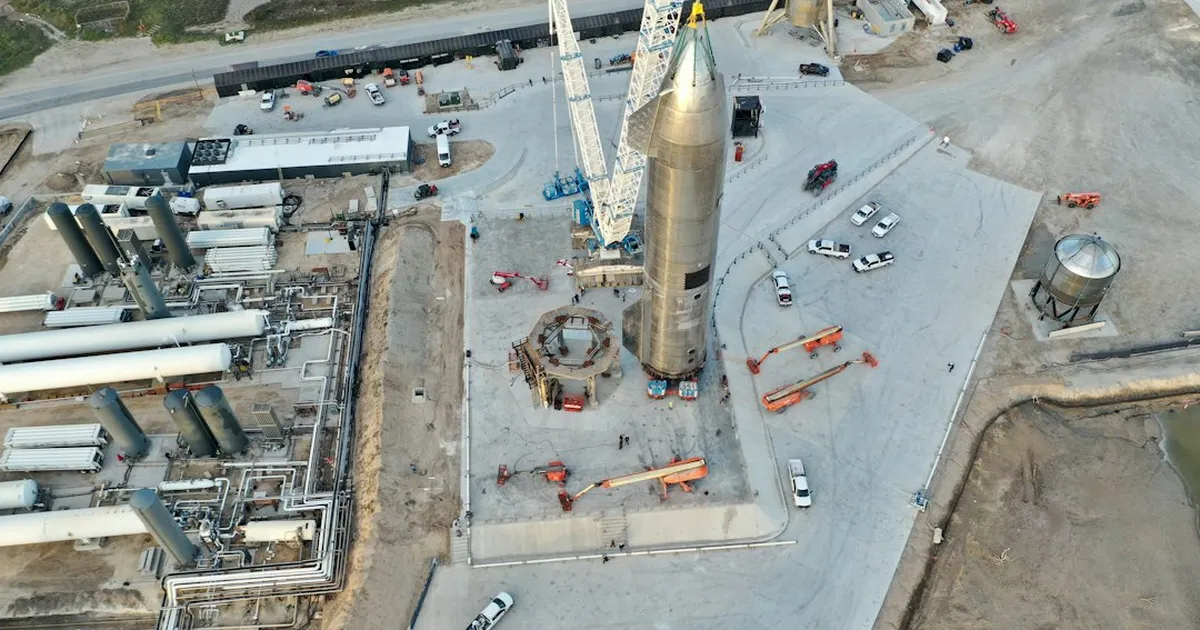
During the 15th test flight of its Starship rocket system at Starbase, Texas, over the weekend, SpaceX succeeded for the first time in catching the upper stage returning from orbit. SpaceX confirmed the catch in a statement on X, and SpaceX founder Elon Musk congratulated the team. The Super Heavy lower stage exploded over the Gulf of Mexico.
Around 20 hours after launch, the upper stage returned to the launch pad and was caught while hovering, according to Deutschlandfunk and Frankfurter Rundschau. The spacecraft had previously deployed 26 Starlink satellites at an altitude of around 260 kilometers and significantly reduced its orbital speed of around 27,000 kilometers per hour during its descent under extreme heat.
SpaceX aborts catch, booster is steered into the sea
For the first time, both stages of the system were to be secured at the launch tower during this flight, after SpaceX had already successfully caught the booster on three earlier test flights. After stage separation, one of the 33 Raptor engines failed while turning for the return burn, according to Huot; 32 fired during the so-called boostback maneuver. During the subsequent landing approach, the booster activated 13 engines as planned, then aborted the catch and blew itself up using its flight termination system a few feet above the water, around 6.5 minutes after launch. SpaceX spokesperson Dan Huot initially said the booster had shut itself down because its guidance, navigation and control (GNC) system had detected a problem.
Musk cites engine performance as preliminary cause
Musk himself offered a preliminary explanation on November 14: Slightly lower than expected engine performance had led to a fuel shortage in the cooling circuit, causing the green flame observed during the flight. However, a full evaluation of the flight telemetry was needed before a definitive assessment could be made with a high degree of confidence, Musk wrote. As a remedy, Musk cited improved, more consistent engine performance, already in development with the Raptor V3.2 version, as well as a small adjustment to the flight software so that the first engine shutdown would occur around one second earlier in future, leaving sufficient fuel reserves for the return and landing. In his assessment, the loss of this booster does not change the timeline for frequent, fully reusable Starship flights because early versions have already been superseded by improved designs in production or on the test stand.
Reusability as a goal, heat shield still a work in progress
The rocket's full reusability is a prerequisite for rapid and inexpensive reuse, according to SpaceX representatives. DW, however, reported that the heat shield made of black, hexagonal tiles was not yet fully reusable and that SpaceX was working on new designs that would require hardly any refurbishment after missions. According to Deutschlandfunk, NASA is investing billions of dollars in the Starship program to take astronauts to the moon under the Artemis program during this decade and support the construction of a permanent lunar base.