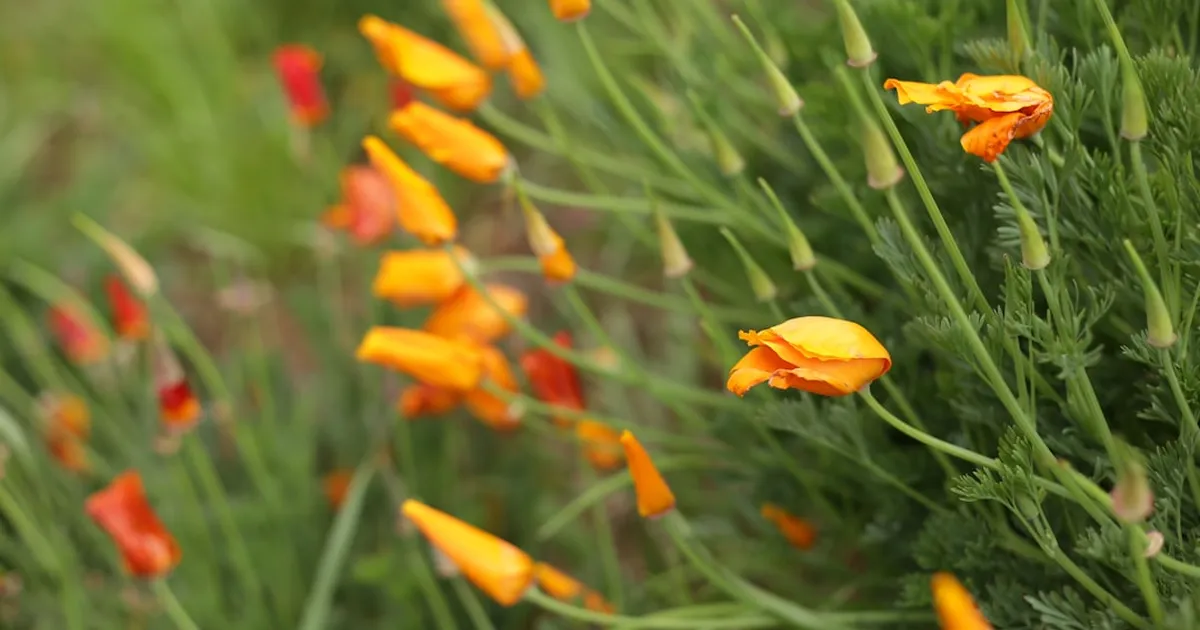
A study from Cornell University, published in the journal Science in March 2026, has produced the first fully documented case of what biologists call "evolutionary rescue": a plant population that nearly collapsed under an extreme climate shock and recovered because genetic changes matched the threat precisely. The scarlet monkeyflower (Mimulus cardinalis) survived California's worst drought in 1,200 years, not by chance, but through natural selection in real time. That is a new finding for climate biology.
What Evolutionary Rescue Means
Evolution is commonly understood as a slow process: millions of years for the development of eyes, millennia for adaptation to shifting climate zones. Evolutionary rescue describes a narrower special case. A population nearly collapses under an acute threat; most individuals die, but a genetic minority survives because it happens to carry the right traits. Their descendants take over the population. The species survives.
Previously this phenomenon was documented primarily in laboratory settings and with simple organisms. Partial evidence existed for Tasmanian devils responding to facial tumor disease and for killifish adapting to polluted estuaries in North America. The new study by lead author Daniel Anstett and his team is, by current scientific consensus, the first rigorously documented case in the wild: the genetic shift occurred, and it was causally responsible for the demographic recovery of the population.
The Megadrought as a Natural Experiment
The drought that struck California between 2012 and 2015 was the worst in approximately 1,200 years. It killed more than 100 million trees according to US agency estimates. Trees could not adapt: they need decades to reach the next generation, and the drought lasted only four years.
The scarlet monkeyflower had a structural advantage. It is an annual plant that produces a new generation within a single season. That means genetic shifts become visible within just a few years. And that is exactly what Anstett's team observed. Individual populations declined by up to 90 percent. Then they recovered to earlier sizes in just two to three years.
What the Geneticists Found in the Genome
Over eight years, the researchers analyzed 55 populations of the monkeyflower at 19 sites in California and Oregon. They sequenced thousands of genomes and tracked population sizes annually. The question was not only whether something had changed, but whether the change causally explained the survival.
The populations that recovered most strongly had spread genetic variants during the drought period that cause their stomata to open less widely. Stomata are the microscopic pores on leaf surfaces through which plants absorb carbon dioxide while simultaneously losing water through transpiration. Less open stomata means less water loss. In normal rainfall years this is a disadvantage, because less photosynthesis is possible. In the drought it was a survival advantage.
Critically, the mutations were not new. Anstett and his team showed these variants were already present in the populations, but at low frequency. The drought acted as a selection pressure. Plants carrying these variants survived more often, produced more offspring, and their gene variants spread rapidly. Without this existing genetic diversity, the populations could not have been rescued.
In Comparison: How Fast Evolution Can Actually Be
The most well-known case of rapid evolution in nature is the peppered moth (Biston betularia) in England. In the 19th century, industrial soot darkened birch tree trunks, and the dark color variant of the moth rose from rare individuals around 1848 to approximately 98 percent of the population in industrial cities like Manchester by 1895, nearly 50 years, no population collapse, but a dramatic genetic shift. When the Clean Air Acts of the late 20th century cleared the air again, the light-colored moths returned.
Another widely discussed example is Darwin's finches on the Galápagos Islands. When a 1977 drought on Daphne Major eliminated small seeds and left only large ones, birds with deeper beaks preferentially survived. Peter and Rosemary Grant documented measurable beak changes within a single breeding generation. But the finches did not suffer 90 percent mortality, and recovery came not from genetic rescue but from immigration from other islands.
The monkeyflower combines both: it endured the 90 percent mortality, had no immigration from other populations, and recovered anyway. Within seven years, one-seventh of the time the peppered moth required.
Which Plants Can Be Rescued and Which Cannot
The discovery offers hope, but with clear limits. For evolutionary rescue, a species needs three conditions simultaneously: a short generation time so selection can act quickly; genetic diversity so there is something to select for; and a climate event that does not kill all individuals simultaneously, otherwise there are no survivors to carry the next generation.
For trees, these conditions are barely achievable. The more than 100 million trees that died in the same drought could not evolve fast enough. For annual plants with a broad genetic base, they are realistic, provided populations remain large and genetically diverse.
The implication for conservation policy: maintaining genetic diversity within a species is at least as important as maintaining the number of individuals. A population impoverished by isolation or inbreeding cannot respond to extreme events even when many individuals exist. Anstett's team is currently investigating which other plant species with similar characteristics might be candidates for evolutionary rescue.