
Farmers who want mango shade and avocado yields do not cut their trees. This economic principle drives the TREPA project through Rwanda's dry Eastern Province: trees are integrated directly into existing farmland, not planted on separate parcels. When farmers benefit immediately from the trees, they tend them. An independent midterm evaluation from November 2025 confirms the approach works: 43,800 hectares restored, 73 percent of the total goal of 60,000 hectares.
2021: Green Climate Fund Backs Rwanda's Most Vulnerable Region
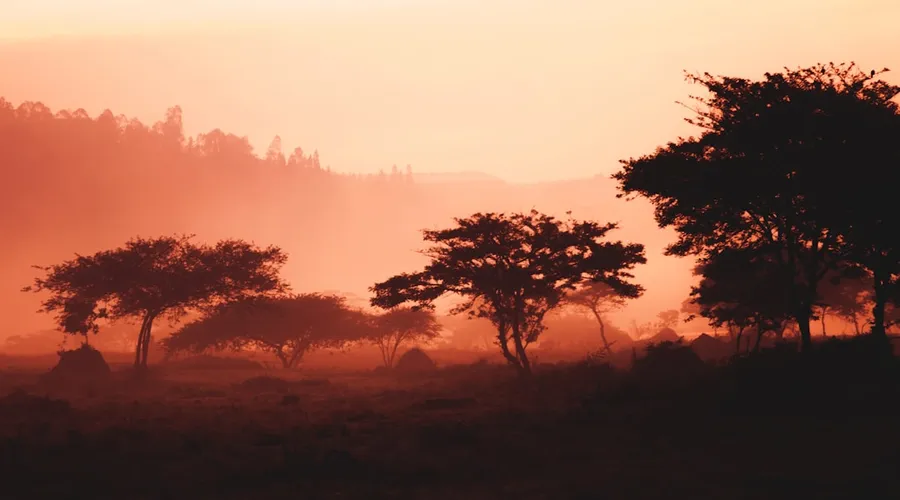
Rwanda's Eastern Province is the country's largest agricultural area and its most vulnerable. Rainy seasons are shrinking and becoming more intense; droughts grow more frequent. Smallholder farmers dependent solely on rainfed agriculture lose harvests when rains fail. Bare hills and depleted soils mark much of the seven districts. Wildfires, erosion, and overuse have degraded the landscape over decades.
In 2021, the United Nations Green Climate Fund (GCF) approved $33.8 million for TREPA. Implementation went to the International Union for Conservation of Nature (IUCN) working with Rwanda Forestry Authority (RFA), the research centers CIFOR-ICRAF, and the development agencies Enabel, Cordaid, and World Vision. The goal: transform 60,000 hectares of degraded land in seven districts into climate-resilient ecosystems while strengthening the livelihoods of 75,000 smallholder farming families.
2022 to 2023: First Major Planting Wave
A formal technical project launch took place in Kigali in January 2023, bringing together officials from the Eastern Province, national environmental authorities, and international partners. In the 2023-2024 planting season, the project planted more than 18,000 hectares of native tree species. That is roughly equivalent to the combined area of Frankfurt and Darmstadt.
TREPA uses four approaches simultaneously: afforestation with native species on degraded land, agroforestry on farmland (trees and crops grown together), silvopastoral systems on pasture (trees among grass), and erosion control on vulnerable slopes. This approach distinguishes TREPA from pure reforestation programs: trees integrate into existing agriculture, not separate parcels. Higher survival rates follow because farmers gain economic benefit from the trees.
2024 to 2025: Midterm Results in Numbers
An independent midterm evaluation from November 2025 documents clear progress: 43,777 hectares restored, including 28,801 hectares of farmland through agroforestry, 7,456 hectares of pasture through silvopastoral systems, and 6,250 hectares of forest plots under sustainable management. Overall, 17.8 million seedlings were planted and 289,339 fruit trees distributed to 72,334 households. Fruit trees create direct economic incentives: farmers who value their mango shade and avocado yields keep the trees.
During the 2024-2025 planting season, TREPA supported Rwanda's national tree-planting initiative with over 65 million seedlings. According to IUCN reports, 236,695 people adopted climate-resistant practices.
Africa's Restoration Efforts: Comparison and Lessons
Rwanda's Eastern Province is not alone. The AFR100 initiative, adopted by 34 African countries, aims to restore 100 million hectares of African land by 2030. Rwanda committed early, targeting two million hectares by 2030.
A comparable large-scale project runs in Ethiopia, where the Green Legacy Program plants seedlings by the billions annually. Government figures say volunteers planted 350 million trees in a single day in July 2019. But researchers at the Ethiopian Environment and Forest Research Institute found that survival rates of planted seedlings drop below 50 percent without systematic aftercare. Numbers alone reveal little without maintenance structures in place.
TREPA differs precisely here. Because trees integrate into existing farming, farmers become the stewards. Distributing fruit trees to over 72,000 households creates ownership incentives that pure reforestation programs lack. The Green Climate Fund's cost model also emphasizes long-term sustainability: funding goes not to a corporation but to a government implementing body with IUCN as technical partner.
73 Percent at Midterm: Completing 16,000 Remaining Hectares by 2027
TREPA runs until 2027. At the current pace, the remaining two years will suffice to restore the missing 16,200 hectares. Three conditions must hold. First, rains must be adequate for seedlings to grow. The Eastern Province has maintained two regular planting seasons annually despite drought risk. Second, GCF funding must continue as planned. Third, smallholder farmers on whose private land much of the agroforestry sits must sustain the new practices after the project ends.
For other East African countries, Rwanda's TREPA demonstrates a financing model that could serve as a blueprint: the Green Climate Fund as first funder, international conservation organizations as technical partners, and national forest authorities as the lead actor on the ground. Uganda and Tanzania currently discuss similar structures for their degraded highland regions, according to CIFOR-ICRAF. Success depends on whether those governments can build comparable implementation capacity to Rwanda's Forestry Authority.