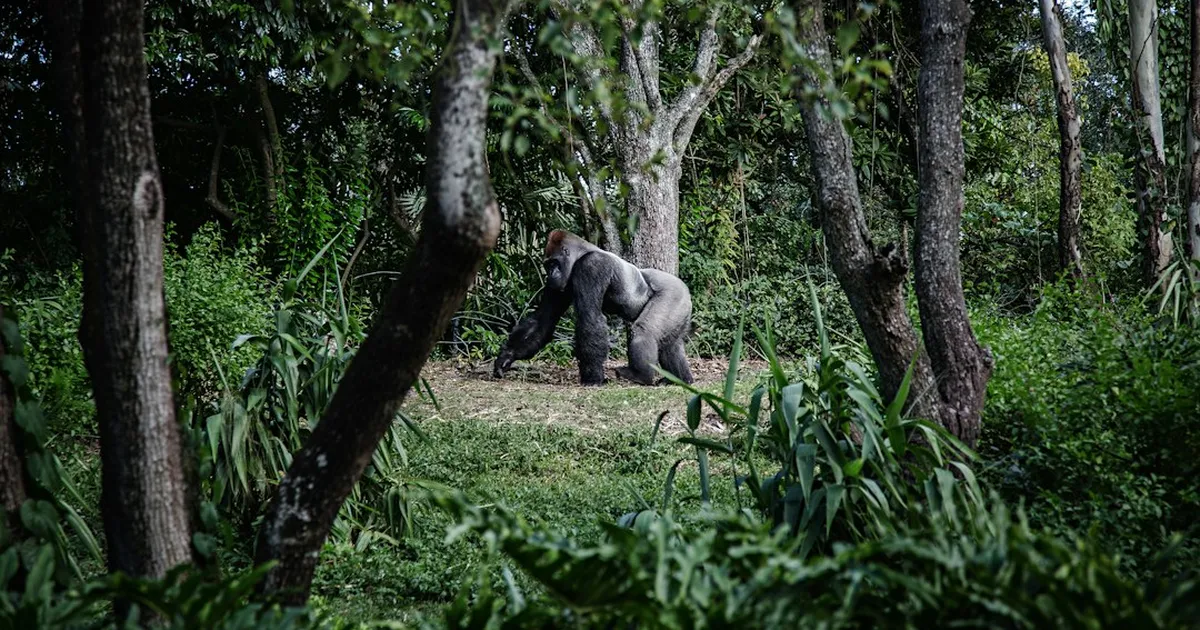
On 21 May 2026, gorilla Lulingu gave birth in Virunga National Park in the Democratic Republic of Congo, making her one of the first eastern lowland gorillas ever successfully returned to the wild to produce offspring. The father is wild silverback Mwasa, who lives with his group on the mountain where Lulingu has integrated since her release. Dr. Cedric Kibengo, field veterinarian at Gorilla Doctors who has monitored the health of all eastern lowland gorillas on Mt. Tshiaberimu since 2024, stated that mother and infant are healthy and thriving.
From rescue to motherhood
Lulingu was only 18 months old when she was taken from her family and sold into illegal wildlife trade. The Democratic Republic of Congo's conservation authority ICCN and Gorilla Doctors rescued her, making her the youngest orphaned gorilla ever brought to the GRACE rescue center, the only facility worldwide for rescued eastern lowland gorillas. GRACE initially cared for her round the clock before gorilla Pinga took on the role of surrogate mother, integrating her into the larger GRACE gorilla family that included Mapendo, Ndjingala, and Isangi, three females who would later return to the wild alongside Lulingu. Jackson Kabuyaya Mbeke, GRACE's country director in DR Congo, said he had been with the facility since its founding and Lulingu's journey reflected everything they had hoped for, watching her arrive as the youngest orphan, grow up in a surrogate family, return to the wild, and now become a mother for the first time.

Why four females were released in 2024
Lulingu was one of four females brought from the GRACE sanctuary in Kasugho to Mt. Tshiaberimu in Virunga National Park in late 2024. The motivation was a population viability analysis concluding that the small, isolated gorilla group on the mountain faced high risk of extinction within 50 years without the addition of reproductive females. The release marked the conclusion of a multi-year rewilding process led by GRACE, Virunga National Park, and local communities, with support from Gorilla Doctors and Re:wild.
How the monitoring team discovered the pregnancy
Virunga's gorilla monitoring team has closely watched the family group since the four females' release in December 2024 and documented their mating with Mwasa. Beyond observing feeding behavior, the team collected non-invasive urine samples from leaves and used standard human pregnancy tests to detect elevated hormone levels indicating pregnancy. Mary Brown, Africa Program Lead at Re:wild, called the new life a sign of resilience and recovery and what is possible through long-term care, collaboration, and targeted protection.

Mother and infant reported healthy
According to Gorilla Doctors, none of the four rewilded females has required veterinary treatment since release, and with Lulingu's infant, another patient has joined their care. Both mother and infant are healthy. Benoit Ishaba, head of gorilla monitoring on Mt. Tshiaberimu and ranger at Virunga National Park, reported that Lulingu is doing a great job and remains central to the family group. Staff have observed her nursing, carrying, and playing with the baby, while another young gorilla in her group has shown interest and Lulingu has been patient with him. Although all four females had interacted with young gorillas at GRACE, none had previously raised an infant themselves. Katie Fawcett, scientific director and CEO of GRACE Gorillas, called the birth a milestone for the species and expressed cautious optimism that Lulingu will manage motherhood well and the infant will survive. Regardless of outcome, she said, it represents another historic first for species conservation.
Context: A population on the brink of extinction
The eastern lowland gorilla, also called Grauer's gorilla, is classified by the International Union for Conservation of Nature (IUCN) as critically endangered. A 2016 published study estimated only around 3,800 Grauer's gorillas remain in the wild, a 77 percent decline within a generation. Before civil war, the population was estimated by the authors at 9,000 to 16,900 animals. In the former stronghold of Kahuzi-Biega National Park, populations fell by 87 percent. On Mt. Tshiaberimu itself, the documented history of decline extends further back: in 1959, zoologist Schaller found 20 gorillas in four groups during a two-week stay and estimated the total population at no more than 40 animals. A 1986 examination by Conrad Aveling concluded that no more than 20 individuals remained, and by 1998, according to Virunga National Park, only 16 gorillas survived when the Gorilla Organization, funded by author Michael Crichton, began supporting protection efforts. A 2023 published study by Iyer and colleagues put the mountain population at 6 Grauer's gorillas, including only 2 adult females.
Threats facing the small population
How high infant mortality is for eastern lowland gorillas in the wild has not yet been systematically studied. For the closely related mountain gorilla species, infant mortality is about 35 percent according to Virunga National Park. The authors of the population viability analysis itself note that factors such as inbreeding depression, habitat quality, disease risk, and human pressure would need to be evaluated in later planning phases. Agricultural encroachment around the entire boundary of Mt. Tshiaberimu is identified as the single greatest threat to the area and its gorillas in a park report. Given gorillas' complex social dynamics, it is also possible that one or more females will not remain permanently with Mwasa but instead join another family group. How many animals currently live on the mountain cannot be determined with certainty from the available reports: after the reinforcement in late 2024, the number rose from eight to twelve according to Virunga National Park, though another publication from the same park lists nine elsewhere without explaining the difference. At least one other rewilded female may also be pregnant and give birth in coming weeks or months.