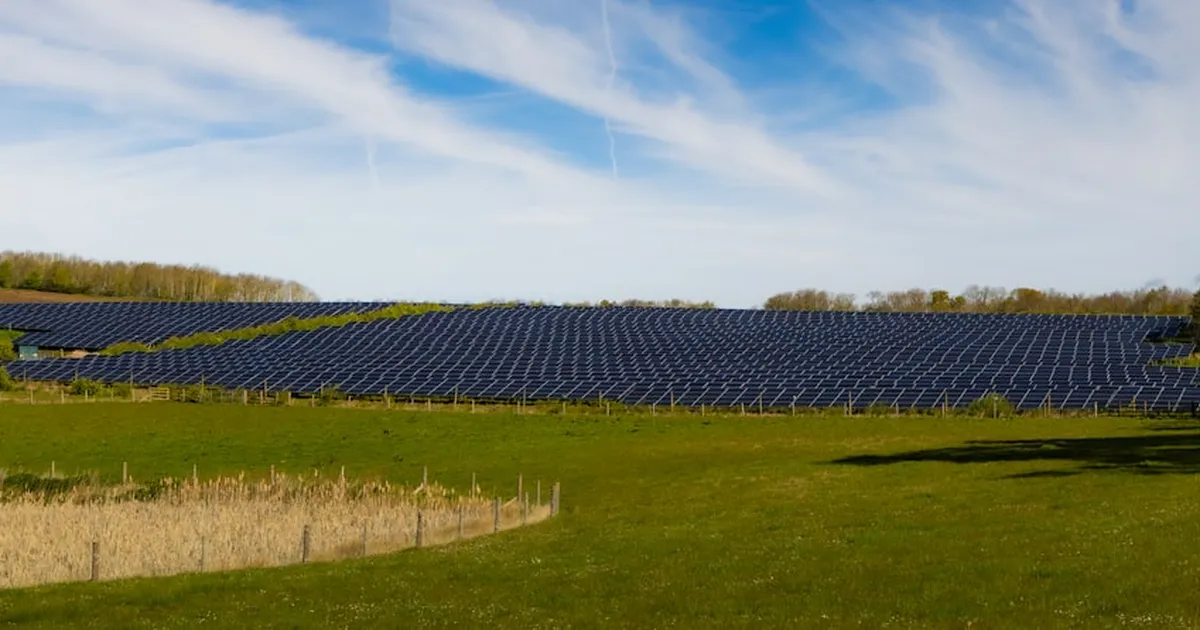
The world installed more renewable energy in 2025 than ever before. A record 692 gigawatts of new capacity came online in a single year, a 15.5 percent increase on 2024. But the more striking figure is 85.6 percent: for the first time in the history of electricity generation, more than eight out of ten megawatts of new power capacity installed worldwide came from wind, solar and water. New fossil fuel plants have been reduced to a sideshow.
What the Gigawatt Numbers Mean
The International Renewable Energy Agency (IRENA) published its annual review in early April 2026. Global renewable capacity reached 5,149 gigawatts in total. One gigawatt is roughly equivalent to the output of a large nuclear power plant. In 2015, total global renewable capacity stood at around 1,800 gigawatts. It has nearly tripled since then.
Of the 692 newly installed gigawatts, solar photovoltaics dominated: 511 gigawatts, three quarters of all new capacity, came from PV alone. Wind energy contributed 159 gigawatts, hydropower 18.4 gigawatts. Biomass and geothermal combined added just 3.7 gigawatts.
Where the Growth Is Happening
Asia remained the center of gravity: 513.3 gigawatts, or 74.2 percent of global additions, came from the continent, representing growth of 21.6 percent over 2024. China dominated the picture: 119.4 gigawatts of new wind capacity was added there alone, and 96 percent of all global hydropower projects were located in China.
Equally notable is the pace of growth in regions that previously barely registered. Africa recorded the highest growth rate of any continent at 15.9 percent, equivalent to 11.3 gigawatts of new capacity. The Middle East expanded by 28.9 percent. These regions are building out at a moment when solar panels are cheaper than at any point in history. A solar farm coming online today in Egypt or South Africa generates electricity at a cost no new coal plant can match.
Why the Market Share Matters More Than the Absolute Number
The most significant finding in the IRENA report is not the absolute figure but the market share. When 85.6 percent of all newly installed global power capacity is renewable, only 14.4 percent of new investment in power generation is flowing into fossil fuels. The explanation is straightforward economics. In most markets, solar power is now cheaper than electricity from new coal or gas plants. IRENA puts the average levelised cost of solar power on a project basis in 2024 at $0.044 per kilowatt-hour, a 90 percent decline since 2010.
Anyone building a power plant today without fossil fuel subsidies builds solar or wind. This is not climate policy; it is business economics.
How Far the Path to the Climate Target Still Is
692 gigawatts is a record, but not yet sufficient. IRENA estimates the world needs to install at least 1,000 gigawatts per year until 2030 to keep global warming within 1.5 degrees Celsius. The gap currently stands at around 308 gigawatts a year. The annual growth trend runs at 15 to 16 percent; if this pace holds, the 1,000-gigawatt mark would arithmetically be reachable around 2027.
More critical than raw generation capacity is the question of storage and grid infrastructure. Fast-growing solar capacity produces abundant electricity during the day and none at night. IRENA explicitly notes in its report that the physical expansion of grid lines and battery storage lagged behind capacity additions in 2025. Without a determined catch-up on grid infrastructure, a portion of the renewable potential risks going unused.
Outlook
Another record addition is already taking shape for 2026: permitting processes are underway in China for at least 200 gigawatts of new solar parks, and India completed auctions for 60 gigawatts of solar capacity in 2025. Whether the ramp-up to 1,000 gigawatts by 2030 is achievable depends substantially on whether solar expansion in Europe, Latin America and Africa can sustain its recent momentum. The IRENA figures for 2025 show at least this: the trend is moving in the right direction, faster than most forecasts from the previous decade predicted.