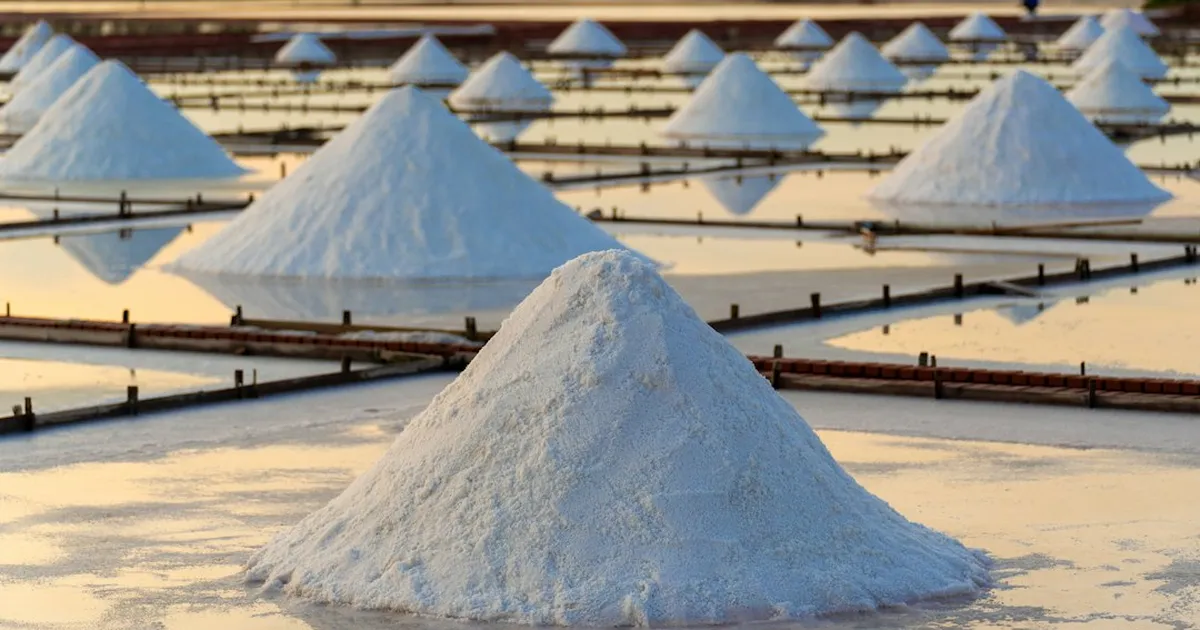
The study, published in Nature Health, modeled the potential health effects for 193 countries. The death estimate is an annual figure; an additional 10.17 million new cases of cardiovascular and chronic kidney disease could also be prevented each year. The authors give an uncertainty interval of 2.81 million to 3.12 million for the death estimate. According to the authors, this figure already accounts for projected additional deaths from hyperkalemia, a dangerously elevated potassium concentration in the blood.
How the model arrives at the figure
In potassium-enriched salt, some of the sodium chloride in ordinary table salt is replaced with potassium chloride. Cardiologist Cheng-Han Chen, who was not involved in the study, describes the mechanism as follows: sodium causes water retention and higher blood pressure, while potassium helps the kidneys remove sodium from the body and lower blood pressure. For their model, the researchers assumed a salt mixture of 75 percent sodium chloride and 25 percent potassium chloride. They took the relationship between sodium and blood pressure from a 2014 study by Mozaffarian and others, and the effect of potassium on blood pressure from a meta-analysis by Filippini involving only 32 studies, which the authors themselves describe as the best available data. Data from studies of ready-made salt substitutes were not included in the model because there were too few comparable studies involving different formulations; instead, the researchers added together the separately calculated effects of less sodium and more potassium. According to the authors, the model is based on data that are several years old and numerous assumptions; they say a large-scale switch would take years.

Different scenarios, different benefits
The researchers also calculated partial scenarios: switching only the salt used at home could, according to their calculations, prevent 1.85 million deaths and 6.19 million cases of disease annually. Switching only the salt in processed foods and restaurant meals would, according to their calculations, prevent 1.56 million deaths and 5.46 million cases of disease. However, these two partial effects do not simply add up to the overall effect: when both salt sources are fully replaced, the limits on effects assumed in the model are reached more quickly than when each is replaced separately, which is why the sum of the individual scenarios exceeds the effect of the combined replacement. The study provides separate estimates for individual countries: an estimated 1.08 million deaths could be prevented annually in China, and just under 400,000 in India. For the United Kingdom, the study gives a figure of almost 13,000 deaths prevented annually, and for the United States, the researchers estimate nearly 105,000. The background, according to the World Health Organization, is that about one in three adults worldwide aged 30 to 79 has high blood pressure, around 1.4 billion people.
What real-world studies have shown so far
Unlike the new modeling study, some of the existing evidence from practical trials is based on a study involving 20,995 participants in rural China published in the New England Journal of Medicine in 2021. The stroke rate was 29.14 rather than 33.65 events per 1,000 person-years when a salt substitute was used instead of ordinary salt. However, the benefits for mortality and cardiovascular events are largely driven by one large Chinese study; without it, the result for all-cause mortality was no longer statistically significant, and studies outside China provided no mortality data at all. The authors therefore conclude that the mortality evidence is barely generalizable to populations other than Chinese people with high consumption of salt they add themselves. They call for large studies in non-Chinese populations. The Cochrane review found average reductions in systolic blood pressure of 4.76 mmHg and in cardiovascular mortality of 180 cases per 100,000 person-years, both with moderate certainty of evidence. However, the evidence remained very uncertain for several other outcomes. All 26 included studies also excluded people for whom increased potassium intake is known to be potentially harmful.
For people with stage 3 to 5 chronic kidney disease, the researchers behind the new modeling study estimated that the switch could prevent around 750,000 deaths annually through lower blood pressure, but at the same time cause about 100,000 deaths through hyperkalemia. Widespread adoption could therefore leave people with advanced kidney disease and patients taking certain medications that raise potassium levels susceptible to hyperkalemia. Jha also considers patient education, clear product labeling and medical supervision effective in limiting risks for patients taking certain medications that raise potassium levels. The American Heart Association therefore recommends that people with kidney disease or taking medications that affect potassium balance seek medical advice before using such products.
In comparison: What has actually been measured so far
Two completed comparisons help put this in perspective. The previously mentioned Chinese village study measured a 12 percent lower risk of premature death compared with ordinary salt. The second case: the same Cochrane review found probably slightly lower cardiovascular mortality, with 180 fewer cases per 100,000 person-years compared with ordinary salt. To give a sense of scale: cardiovascular diseases were responsible for 19.2 million deaths worldwide as of 2023; the new model estimate of 2.96 million deaths prevented covers chronic kidney disease as well as this group of diseases.
What obstacles make a widespread switch difficult
Bruce Neal, Senior Professorial Fellow at the George Institute, calls for the food industry in Europe and North America to be involved because more than 70 percent of salt consumption there comes from processed foods and restaurant meals, rather than salt added at home. One manufacturer shows that partial steps are already possible: according to the company, HKFoods has, since January 2025, replaced some of the salt in nearly 100 popular meat and sausage products with a flavoring mixture containing potassium chloride, with up to 25 percent less salt and no increase in product prices. Two other factors make a widespread switch difficult: according to the study, potassium-based salt costs about twice as much as ordinary salt. In addition, Jha says a worldwide switch would require significantly increased production of potassium chloride to meet demand. In the United States, industry associations called on the Food and Drug Administration, the FDA, in a 2023 submission to also allow salt substitutes in foods subject to mandatory product standards, while warning at the time that reformulation could take between 18 months and 3 years per product.