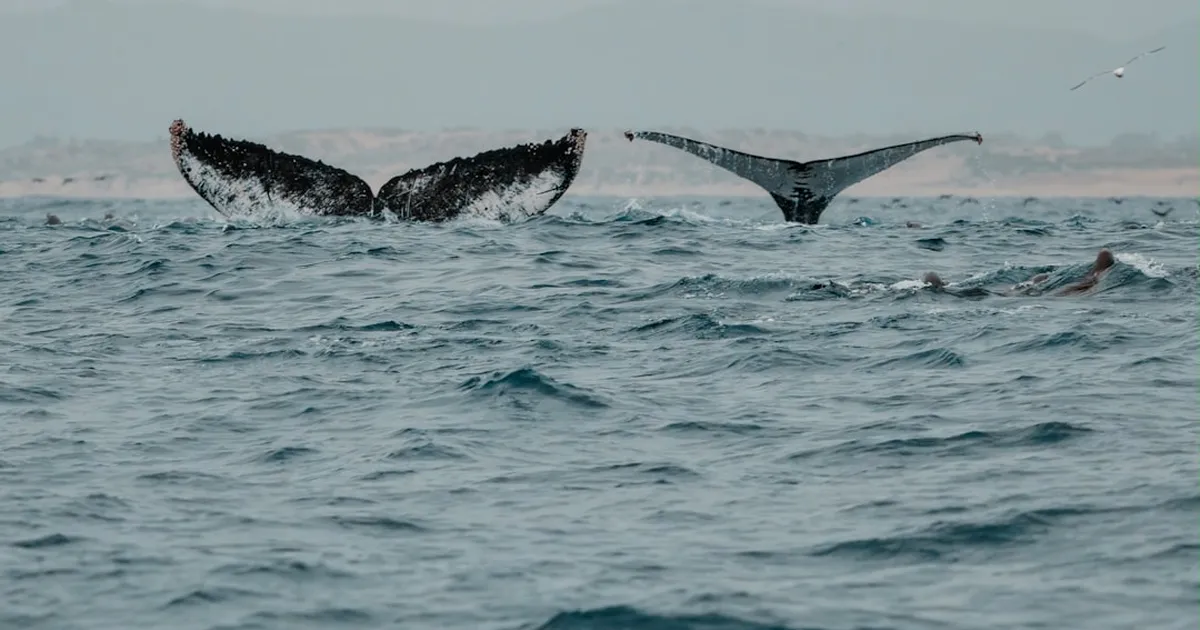
In the 2025/2026 calving season, researchers from the New England Aquarium and the US agency NOAA documented 23 births among North Atlantic right whales, the highest count since 2009. With only 384 individuals remaining worldwide according to NOAA's current estimate, the species is among the most endangered marine mammals on Earth. That the population has now grown for the fourth consecutive year shows how quickly coordinated protective measures can work when consistently enforced.
From 490 to Nearly 360: The Decline of a Whale Species
The population of North Atlantic right whales reached its peak around 2011 with an estimated 490 individuals. Although the species had been protected since the early 20th century, its central threats persisted: entanglement in fishing gear and collisions with vessels. Both causes of death often leave no visible traces and are only discovered during strandings.
In 2017, NOAA declared an official "Unusual Mortality Event" after an unusually high number of sick, injured and dead animals were recorded. By January 2025, this event encompassed 151 documented cases: 41 deaths, 39 serious injuries and 71 sick animals. That corresponds to more than 20 percent of the entire global population. Numbers dropped to around 360 to 370 individuals at their lowest.
Canada's Protective Measures as a Turning Point
The decisive step came from Canada, whose waters in the Gulf of St. Lawrence are a critical feeding ground for the whales. The government introduced mandatory speed limits of ten knots for vessels over 13 meters in length, covering a marine area of more than 65,000 square kilometers. Violations carry fines of up to one million Canadian dollars or 18 months imprisonment according to Transport Canada.
Fishing technologies were also adapted. In certain fishing regions, operators are required to switch to ropeless systems, in which no lines float permanently in the water for whales to become entangled in. Surveillance drones and underwater hydrophones allow whale positions to be tracked in real time, triggering dynamic protections when animals enter shipping routes.
The difference compared to earlier policy is measurable. Voluntary speed limits that applied before 2019 had shown little effect. The mandatory rules brought the change.
2026: 23 Calves, the Strongest Signal in 15 Years
In the season spanning November to April, researchers documented exactly 23 births. The New England Aquarium, which monitors the population jointly with NOAA on a long-term basis, confirmed it is the highest calf count since 2009. Particularly significant: 20 of the 23 new mothers had previously raised calves successfully. This indicates a stable and experienced reproductive population.
The total population is estimated at 384 individuals for 2024, up from 376 in 2023. Measured in absolute terms, this is sobering: the entire global population of North Atlantic right whales would fit inside a single medium-sized football stadium. But the trend is unambiguous: four consecutive years of growth and a calving season that exceeded all expectations.
In Comparison: How Whales Recover After Protection
Other whale species show what is possible over the long term. After the international whaling moratorium of 1986, the humpback whale recovered from an estimated 5,000 individuals to over 80,000 today, a tenfold increase in under 40 years according to the IUCN. Humpbacks had it easier: once removed from direct hunting, the main threat was largely eliminated.
For the North Atlantic right whale, the situation is more complex. The threat comes not from whaling but from unavoidable side effects of fishing and shipping. A comparably difficult recovery story is the California condor: in 1987, only 27 individuals existed worldwide. All were captured. Through an intensive captive breeding and reintroduction program, more than 500 condors were alive by 2024, over 300 in the wild according to the US Fish and Wildlife Service. The process took nearly 40 years and required continuous state investment.
The North Atlantic right whale needs no captive breeding, but equally requires decades of sustained protective investment. The 23 calves are an early signal, not cause for complacency.
Without Ropeless Fishing, Recovery Remains Fragile
Three conditions must be simultaneously maintained for the recovery to continue.
First, Canada's protective measures must hold. The mandatory speed limits introduced in 2019 are showing results but remain politically contested. Fishing industry groups regularly cite economic burdens.
Second, ropeless fishing technology must be scaled in US lobster fisheries. Maine and Massachusetts fleets alone account for a substantial share of whale entanglements according to NOAA. The technology exists, but its adoption is expensive and politically contentious. Without progress here, the structural threat persists regardless of how many calves are born.
Third, climate change is altering the distribution of copepods, the right whale's primary food source. Early studies show the animals are abandoning traditional feeding grounds and moving into regions with less protection. For a stable population, the New England Aquarium estimates more than 50 calves per year over many years would be needed. The 23 of this season are a beginning.