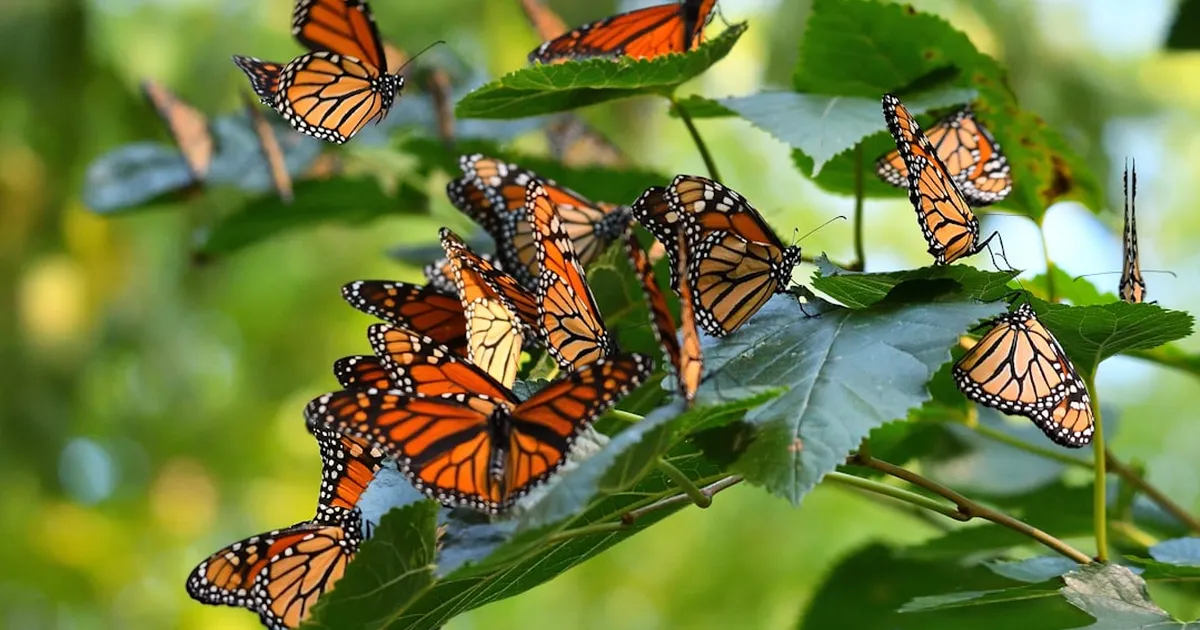
Monarch butterflies are returning in numbers not recorded in years: in winter 2025/2026, the butterflies colonized 2.93 hectares of forest in Mexican protected areas, 64 percent more than the previous season. That is the largest year-on-year increase since 2018. Mexico's environment agency Semarnat and national conservation body Conanp announced the result jointly with WWF Mexico on March 18, 2026. That the number is cause for relief is clear. That it is not enough, equally so.
A Dramatic Decline Since the 1990s
The eastern monarch population migrates each year between the forests of Canada and the United States to overwinter in the mountains of Michoacán. In winter 1995, the butterfly colonies covered around 18 hectares of oyamel fir forest in these protected areas. Since then, the population has fallen to an estimated 10 to 20 percent of that level.
The main causes: widespread herbicide use in the United States has largely wiped out milkweed, the only food source for monarch caterpillars. In Mexico, the overwintering forests have shrunk through illegal logging and wildfires. Increasing drought along the entire migration route exhausts the butterflies during their journey. The International Union for Conservation of Nature (IUCN) has classified the species as endangered since 2022. Scientists set the minimum for survival at a permanently colonized forest area of at least six hectares.
What is measured is not the number of individual butterflies but the forest area covered by dense butterfly colonies: with billions of individuals involved, a direct count is not practical. In winter 2023/2024, the population reached one of its lowest recorded levels at 1.79 hectares.
Why the Population Grew This Year
Researchers attribute the rebound to 2.93 hectares to three interacting factors. Spring and summer 2024 in the United States were wetter than previous years. That improved milkweed availability and led to significantly higher egg and caterpillar rates than in the preceding drought years. During the autumn migration to Mexico, there were fewer drought phases than in the prior season, meaning more flowering nectar sources were available along the migration corridors.
Direct conservation efforts also contributed: in 2025, around 100,000 native oyamel firs were planted at 32 reforestation sites within the Mexican protected areas. In parallel, researchers are for the first time testing microchips on individual butterflies to track migration routes and feeding habits. The results are expected to enable more targeted protection along the entire migration route in coming years.
How Fragile the Recovery Is
2.93 hectares is more than one and a half times the previous year's level, but it represents less than half of the scientifically defined survival threshold of six hectares and only about 16 percent of the area colonized in the record year of 1995. The monarch population responds to climatic conditions with exceptional sensitivity: a single good weather year produces measurable recovery, a single bad one can undo it.
That was demonstrated after a relative upturn in 2022/2023, which was followed by a severe drought the following year, pushing the population to what was then a record low. Pressure from illegal logging also continues: in the period from February 2024 to February 2025, logging alone destroyed 4.58 hectares of protected forest.
A Symbol for an Entire Ecosystem
Monarch butterflies are more than an iconic natural spectacle. As pollinators, they play an ecological role across North America. The annual mass migration, in which millions of butterflies traverse the entire United States, is considered one of the most remarkable natural phenomena in the world and draws millions of ecotourists to the mountain regions of Michoacán.
The current recovery demonstrates that the species has not yet been lost and that both weather conditions and conservation programs can produce measurable results. The U.S. Fish and Wildlife Service is currently reviewing whether to list monarch butterflies under the Endangered Species Act. Such a listing would require federal agencies to set up far more extensive protection and funding programs, including milkweed planting on private land. The next population survey takes place in winter 2026/2027.