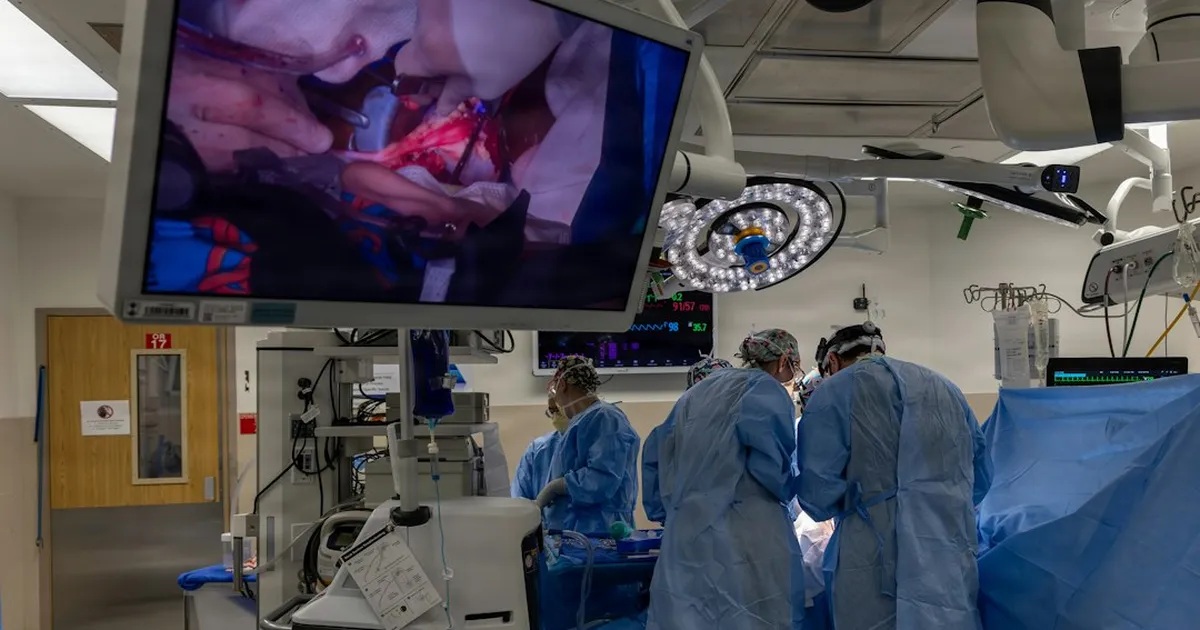
On July 14, 2026, Corewell Health announced the adaptation of mitral valve repair to a robotic approach. The patient was Patrick O’Brien, 60, of Royal Oak, who sought treatment for his long-standing heart murmur after it caused heart palpitations.
Rakesh M. Suri, a Corewell Health surgeon involved in the procedure, said the technique allows the heart to be repaired through a small robotic port and a tiny additional incision, simplifying the procedure, reducing complexity and increasing safety.

The patient ignored his heart murmur for several years
O’Brien said he learned of his heart murmur about eight years before his statement. He said he was told at the time that it was mild regurgitation that needed to be monitored, and that he ignored it for several years until symptoms appeared. According to Suri, he had mitral valve prolapse. Suri said O’Brien was already walking around on the evening of the operation, left the hospital on the third day and helped his family set up a generator during a statewide power outage in Michigan on the fourth day. ClickOnDetroit reported, however, that Corewell Health said he was discharged after four days. O’Brien said he could not be doing better, was nearing the end of his cardiac rehabilitation and felt better than he probably had in the past 20 years.
By comparison: what the UK Mini Mitral study shows
The randomized study found that minithoracotomy was not superior to sternotomy for recovery of physical function after 12 weeks, but achieved high rates and quality of valve repair and similar safety outcomes after one year. The authors themselves point out that their expertise-based randomization may have introduced confounding factors. According to ClickOnDetroit, doctors warned that the new procedure would not replace every form of heart surgery and was not suitable for all patients.
Open questions about the new technique
Suri said his team initially developed the operation in the laboratory and practiced it many times before offering it to Patrick and then to 10 other people. According to a specialist article, the long-term outcomes of the procedure have yet to be determined. According to ClickOnDetroit, Corewell Health planned to continue evaluating the use of the procedure as it expanded it to appropriately selected patients. The long-term outcomes are still pending, according to the specialist article, and doctors say the procedure is not suitable for all patients.