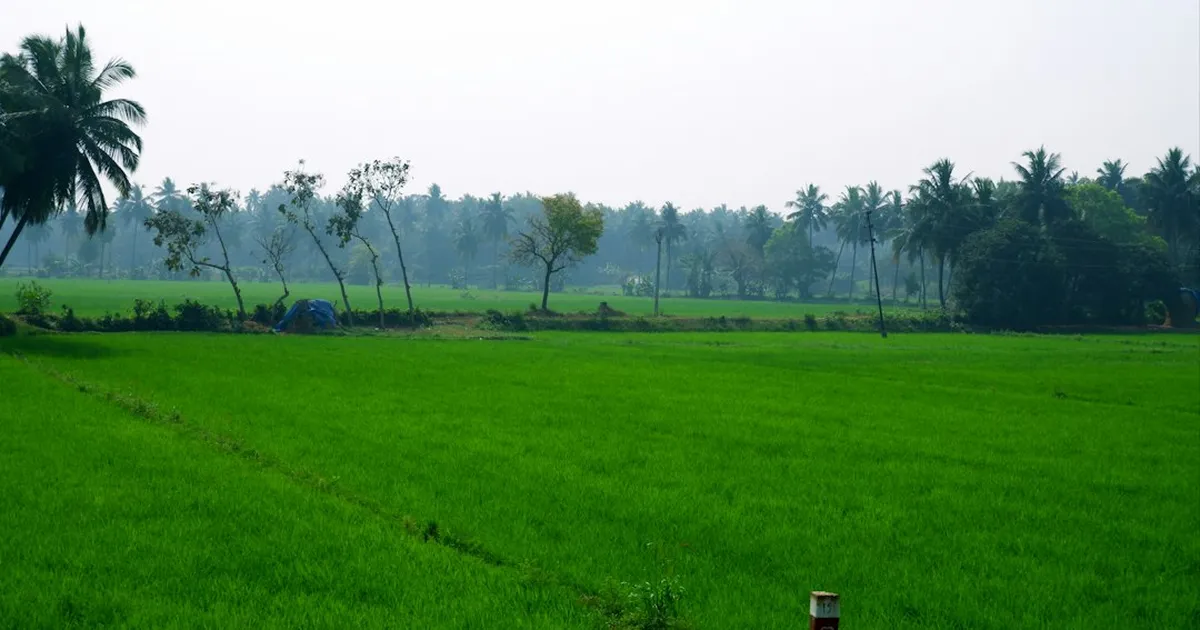
India's agricultural research council, ICAR, said it developed two genome-edited rice varieties using CRISPR-Cas technology, which alters DNA without introducing foreign genetic material. DRR Rice 100 (Kamala) and Pusa DST Rice 1 are the first genome-edited rice varieties India has approved, based on an exemption issued by India's environmental ministry on 30 March 2022.
What ICAR says the new varieties achieve
Kamala, developed from Samba Mahsuri at the ICAR-IIRR institute in Hyderabad, matures 20 days earlier than the original, in about 130 days, and maintains comparable grain quality, ICAR said. Pusa DST Rice 1, developed from MTU 1010 at ICAR-IARI in New Delhi, reportedly increases yields on saline and alkaline soils by 9.66 to 30.4 percent, with potential for up to 20 percent additional production.
ICAR said the varieties combine a 19 percent yield increase with 20 percent lower greenhouse gas emissions. Irrigation water savings would reach 7.5 billion cubic metres, and tolerance to drought, salinity, and climate stress would improve. Field trials showed Kamala averaging 53.7 quintals per hectare and reaching up to 88.96 quintals, representing 19 percent more than the original Samba Mahsuri.
If the varieties were planted on 5 million hectares, ICAR projected 4.5 million additional tonnes of rice, with greenhouse gas emissions falling 20 percent, equivalent to 32,000 tonnes of carbon.
ICAR pointed to an assessment system running since 1965, the All India Coordinated Research Project on Rice, which tests over 1,200 breeding lines annually across 100 locations and has led to approval of more than 1,750 rice varieties and hybrids. The two new lines were evaluated in near-isogenic-line trials in 2023 and 2024, with government representatives, decision-makers, media, and corporate officials, plus over 5,000 farmers visiting test fields, ICAR said.
Agriculture minister Shivraj Singh Chouhan congratulated the scientists and pledged full support for field implementation. ICAR director-general M.L. Jat said, "Today will be inscribed in golden letters" — a significant moment for climate resilience and food security, ICAR framed it.
The Coalition for a GM-Free India's counterargument
On 5 May 2025, the Coalition for a GM-Free India called the release improper, unscientific, and irresponsible. The coalition alleged the government acted under corporate lobby pressure while substantial scientific literature questioned the safety of gene-editing techniques. The varieties were released without rigorous safety testing, the coalition said, under a banner of yield and drought benefits.
In developing Pusa DST Rice 1, gene-editing deleted 366 base pairs; in Kamala, 33 base pairs. The SDN-1 technology used could generate unintended mutations outside the target site with unknown health and environmental consequences, the coalition said, citing a 2022 study by Chu et al. showing certain DNA damage only detectable with long-read sequencing, a method seldom applied. A May 2020 study by Sukumar Biswas et al., the coalition noted, classified SDN-1 technology in rice as imprecise, reporting larger insertions, deletions, and chromosomal rearrangements.
The coalition argued the 2022 deregulation of SDN-1 and SDN-2 was itself unlawful, as all gene-editing falls under definitions in India's 1989 environmental protection rules. Institutional Biosafety Committees, which review SDN-1 and SDN-2 research and can issue exemption certificates, present a clear conflict of interest, the coalition said. The coalition called for reverting the exemption under Rule 20 and bringing all agricultural and animal gene-editing back under full GM organism protocols.
Intellectual property rights remain unclear. The coalition pointed to patents held by the U.S. Broad Institute, currently contested in court, and patents by the University of California and University of Vienna filed in India, recently challenged. The coalition demanded transparent disclosure. Major export markets, particularly in the Middle East and Gulf region, reject genome-edited rice due to public opposition to genetic modification, the coalition added, saying the release violates a July 2024 Indian Supreme Court directive and amounts to contempt of court. The coalition rejected government claims that higher yields would shrink cultivation area and free land for pulses and oil crops, calling the assertion baseless.
Where both sides agree
ICAR and the coalition do not dispute one fact: both classify the varieties as SDN-1 and SDN-2 and reference the same 2022 exemption. The disagreement centers on whether this classification and the simplified evaluation it permits offer sufficient safety or, as the coalition contends, create an impermissible gap in regulatory oversight.
ICAR's rebuttal of November 2025
On 26 November 2025, ICAR countered the coalition's allegations point by point. The agency said the coalition's real objection was not to the evaluation process itself but fundamentally to gene-editing technology. ICAR accused the coalition of selective presentation of individual site data, doing Indian science a disservice.
No public response from the Coalition for a GM-Free India to this rebuttal appears in reviewed sources. The dispute remains unresolved as of late 2025: a state research agency maintaining that its approval is scientifically grounded and legally sound, opposed by a coalition of organizations calling the evaluation insufficiently rigorous and unlawful.