
When charred bones are exposed to blue light, they glow red. Researchers exploited this physical property to secure fire evidence from a depth no natural fire would have reached: 30 meters deep within Wonderwerk Cave in South Africa. The result is the oldest confirmed evidence of human fire use: 1.79 million years. Nearly one million years earlier than previously known.
What researchers found 30 meters deep in limestone
Wonderwerk Cave lies in the Northern Cape, within South Africa's Kalahari semi-desert. The name is Afrikaans for "miracle cave." The cave has been a central paleontological site for decades. In 2012, a team led by archaeologist Michael Chazan from the University of Toronto and paleontologist Liora Kolska Horwitz from Hebrew University Jerusalem previously published fire evidence from Stratum 10, dated to roughly one million years. That was a sensation at the time.
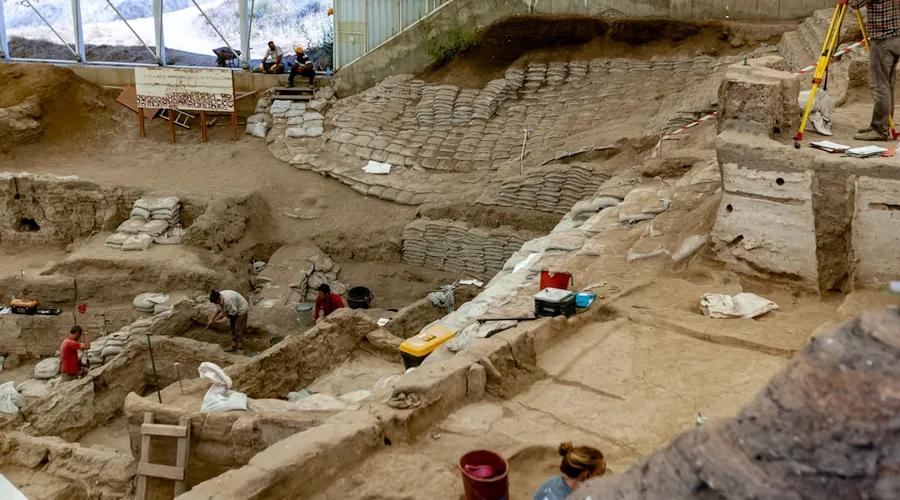
The new study, published in June 2026 in PLOS One, examines the deeper Stratum 11 layer. The team found bones of small animals, originally carried into the cave as barn owl pellets. Several of these bones show traces of intense heating. By itself, this would be insufficient proof: bones can discolor through other processes. Decisive is the location: the find spot lies 30 meters deep within the cave, far outside the reach of natural wildfires or bushfires. Guano residues that might suggest spontaneous combustion are completely absent from the layer.
Moreover, charred bones were not distributed uniformly but clustered in specific spots on the excavation surface, suggesting repeated, localized burn sites. Rudimentary hand axes of the Acheulean culture, associated with Homo erectus, were found in the same layers.
The method that makes the difference
The methodological breakthrough is a newly developed luminescence technique. When bone is exposed to intense heat, its crystal structure changes permanently. When subsequently exposed to blue light, it emits red light. Unheated bone does not. The team illuminated 39 whitish-gray bones from Stratum 10. All 32 bones from Stratum 11 and 21 of the 39 from Stratum 10 showed this characteristic response.
Additionally, researchers employed FTIR spectroscopy, Fourier-transform infrared spectroscopy, to detect chemical changes arising only from intense heat exposure. All 32 bones from Stratum 11 tested positive. Both methods are non-destructive: the rare fossils remain fully intact for future analysis. This is particularly important for paleoanthropological finds, as any material removal irreversibly alters the specimen.
The research team is international: institutions from Spain, Argentina, Canada, the USA, South Africa, Portugal, and Israel participated. The Spanish Instituto de Óptica Daza de Valdés in Madrid contributed the luminescence analytics. Cooperation spanning two decades makes the study an unusually long-term research project.
In comparison: The timeline of fire use
Before the new study, Stratum 10 of the same cave with roughly one million years was considered the oldest confirmed fire use. The Stratum 11 finding pushes this boundary back nearly 800,000 years.
An important comparison point lies outside Africa: at Gesher Benot Ya'aqov, an Acheulean site on the Jordan River in Israel, researchers discovered charred seeds and wood from roughly 780,000 years ago. The 2004 Science publication is considered the oldest evidence of controlled fire use outside Africa. The new Wonderwerk Cave finding is more than twice as old.
A number puts this in perspective: Homo sapiens, our own species, is roughly 300,000 years old by current research. The Homo erectus fire use in Wonderwerk Cave began thus 1.49 million years before the emergence of our own species. Fire was not a new discovery for human ancestors when our species took the stage: it was an almost one-and-a-half-million-year-old practice.
Transport, not fire-making: What the finding tells us about Homo erectus
Co-researcher Yolanda Fernández-Jalvo cautions against overly broad conclusions: the fire was only opportunistically brought there, not yet domesticated. This means Homo erectus probably could not yet generate fire itself. He took it from naturally occurring wildfires, carried it into the cave, and maintained it as long as it burned.
Yet this remains a cognitive achievement, previously undocumented so early: recognizing the utility of a natural phenomenon, transporting it across a distance, actively maintaining it over an unknown duration. What the fire was used for remains unclear. Warmth and protection from predators are the most obvious explanations. Cooking seems unlikely for this early phase.
Michael Chazan, who has worked at Wonderwerk Cave for more than two decades, sees in the new method primarily a tool for the discipline's future. The luminescence technique allows non-destructive application to hundreds of fossils from other paleoanthropological sites. Layers previously considered fire-free might surprise upon re-examination. The 1.79-million-year record may not be the last word.