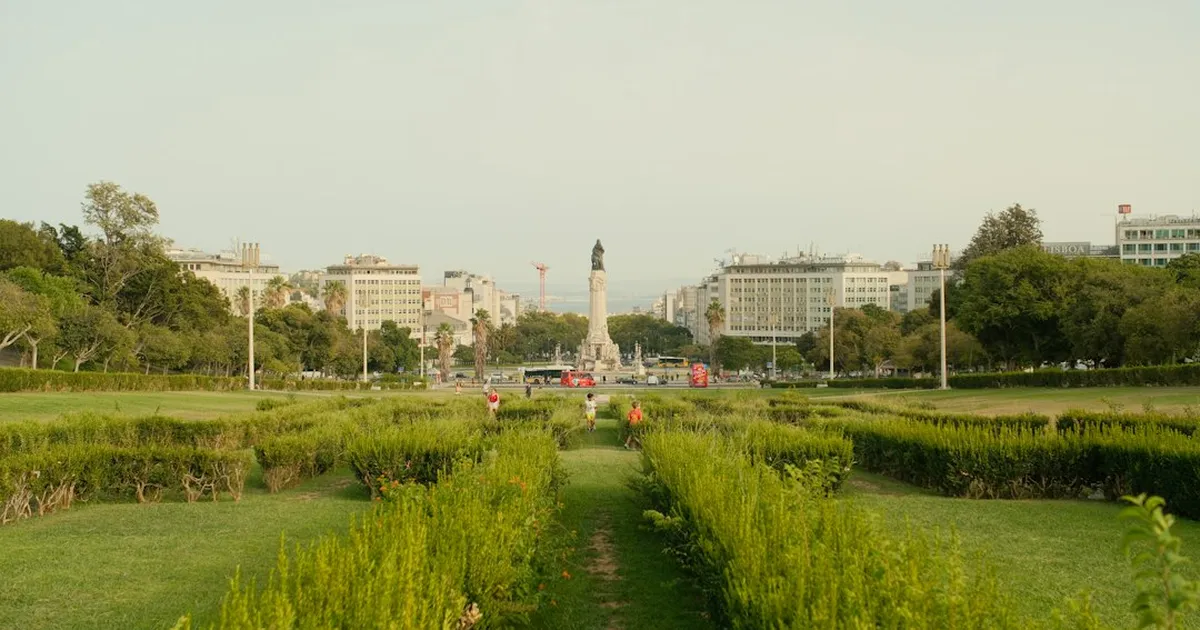
Guimarães in Portugal receives the title of European Green Capital 2026. It cited the city's commitment to continuous improvement across all sustainability challenges and comprehensive results in seven areas of environmental management as the reasons. The jury also highlighted that Guimarães had made sustainability part of its culture and combined creativity with science and data. A total of 21 cities had applied for the Green Capital and Green Leaf awards, and an international panel of seven independent experts selected seven finalists from among them.
An award with a long history
The Commission introduced the European Green Capital Award in 2010 to encourage cities to become greener and cleaner and thereby improve their citizens' quality of life. Guimarães has a considerable history in this regard: The city in the Braga district in northern Portugal was declared a UNESCO World Heritage Site in 2001 because of its well-preserved historic centre, was European Capital of Culture in 2012, European City of Sport in 2013 and Portugal's most sustainable municipality for three consecutive years. The title comes with prize money of 600,000 euros, which the Commission says is intended to fund measures to further increase the city's environmental sustainability during its time as titleholder.

From the award to the official start
In June 2025, Mayor Domingos Bragança and Patrick Child, acting director-general of the Commission's environment department, signed a declaration of intent confirming Guimarães as the titleholder; at the opening of EU Green Week 2025, the city also reaffirmed its goal of becoming climate neutral by 2030. Bragança also announced a sustainability centre called Capital Verde Europeia, which is to be created by 2030 and is intended to promote innovation, research and public participation with an expected investment of nearly 15 million euros. This followed a strategic plan published in February 2025, which designated 2025 as a preparation year and 2026 as a year of celebration under the motto “One Planet City” and provided for the establishment of a dedicated mission unit to coordinate the work. On January 9, 2026, Guimarães said it officially began its title year.
What was already happening in everyday life before the title
The PEGADAS environmental education programme had been running in Guimarães since 2015 and, according to the Commission, was intended to raise awareness and enable the community to adopt sustainable practices. According to the Commission, the city is a member of Zero Waste Europe; according to the Energy Cities network, it uses the PAYT system, under which more household waste means a higher fee and recyclable material is collected free of charge, as well as the RRRCICLO initiative for the recovery of organic waste; an ecological footprint initiative also serves as a framework on the path to becoming a “One Planet” city. According to Energy Cities, the path to climate neutrality dates back to 2013, when Guimarães established the Guimarães 2030 governance ecosystem; the Climate City Pact followed in 2017. Carlos Ribeiro, head of the landscape laboratory in Guimarães, said the city had sought in recent years to improve connectivity to enhance green spaces; temperatures had fallen by two degrees, but more green parks were needed.
Advice on sustainable mobility
The city has also signed an advisory agreement with the European Investment Bank, funded by the Commission, to update the sustainable mobility plan and examine a bus rapid transit system that the EIB says is intended to become the backbone of the long-term strategy to decarbonise urban transport. The work is funded through the Commission's mission for climate-neutral and smart cities, part of the InvestEU programme; Guimarães is among the first Portuguese cities to receive this support.

According to the European Commission, Guimarães hosted an international conference on sustainability in sport in May 2026, at which sports associations, clubs and sustainability experts discussed event management and resource efficiency. According to the European Commission, on May 15, at the closing session of the eleventh edition of the Eco Parliament, students from Guimarães presented environmental projects and spoke directly with Mayor Ricardo Araújo. According to the European Commission, Green Week Guimarães 2026 brought thousands of people to the city centre over four days in early June, with conferences, exhibitions, workshops and concerts.
What comes after Guimarães became clear on October 8, 2026, when the winners of the award for 2028 were announced at a ceremony in Guimarães. Zaragoza in Spain was named European Green Capital 2028, while Benidorm in Spain and Estarreja in Portugal share the European Green Leaf 2028 title. The successor for 2027 has already been decided: Heilbronn in Germany will be European Green Capital, while Assen in the Netherlands and Siena in Italy will receive the Green Leaf. The capital title goes to cities with more than 100,000 inhabitants, while the smaller European Green Leaf title goes to municipalities with between 20,000 and 100,000 inhabitants; in Guimarães' own edition, the latter went to Águeda in Portugal and Vaasa in Finland in 2026. The prize money of 600,000 euros for Guimarães is therefore well below the investment of nearly 15 million euros budgeted for the planned sustainability hub.
According to the strategic plan, Guimarães will hold the vice-presidency of the European Green Capitals network in 2025 and 2026, followed by its presidency in 2027, along with a detailed evaluation of the title year and an interim report to the Commission, before a final report is scheduled for 2028.