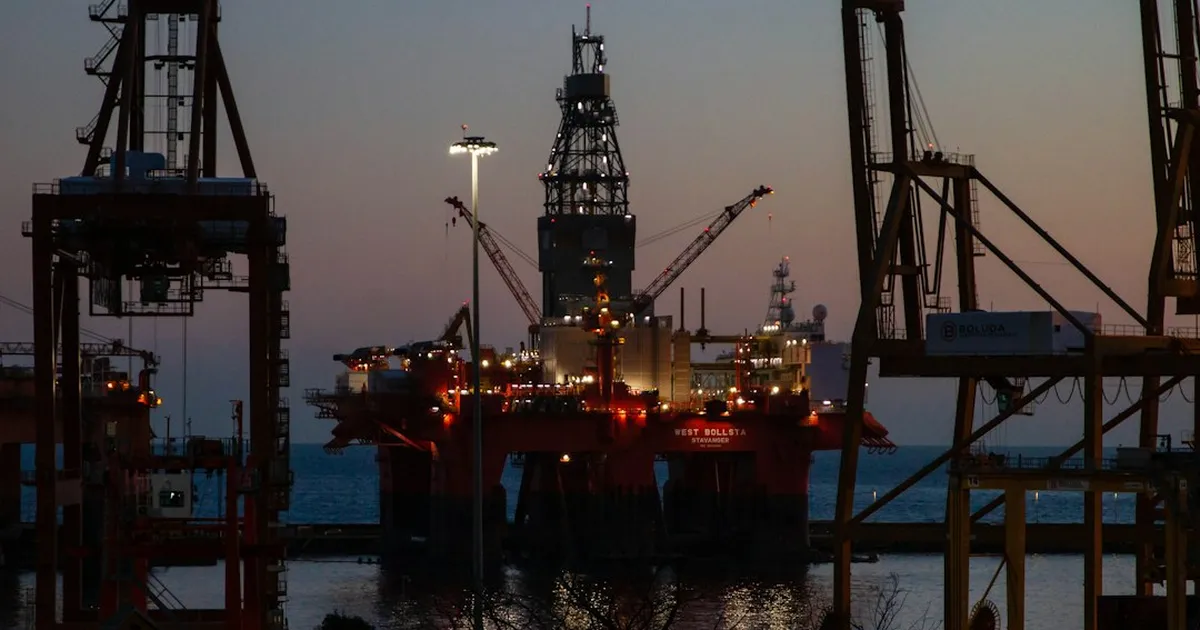
King Frederik X inaugurated Greensand on 18 September 2026 in Esbjerg, Denmark's first and Europe's first full-scale CO2 storage facility in commercial operation. The site, operated by INEOS, will store up to 400,000 tonnes of carbon dioxide annually, injecting it approximately 1,800 metres below the seabed in the Danish North Sea. The EU has set a target of 50 million tonnes annual injection capacity by 2030 – 125 times larger.
What lies beneath the seabed
CO2 is stored in the depleted Nini West oil field, approximately 250 kilometres off the Danish coast. The rock formation has retained hydrocarbons for millions of years. A pilot trial in March 2023 tested injecting up to 15,000 tonnes of CO2 over four months. Commercial operation now scales capacity to 400,000 tonnes annually, according to the consortium – the amount currently available on the market.
INEOS Energy leads the consortium, partnered by Harbour Energy and Denmark's sovereign North Sea Fund (Nordsøfonden). The EU Innovation Fund supported the project with €41 million. CO2 initially comes primarily from Danish biogas facilities, is liquefied, then transported by truck to Esbjerg harbour. From there, the Carbon Destroyer 1 – described as the EU's first purpose-built CO2 transport vessel – carries it to the Nini West platform, where it is injected into storage. The consortium hopes to attract major industrial customers, including German facilities, in future operations.
What 400,000 tonnes actually means
The 50 million tonne target appears in the Net-Zero Industry Act (Regulation (EU) 2024/1735). The European Commission describes it as essential for permanently storing hard-to-avoid industrial emissions, such as from cement plants. The regulation primarily obligates oil and gas producers: the Commission has named 44 companies required to contribute proportionally to storage capacity creation.
Greensand represents a modest start: 400,000 tonnes equal 0.8 percent of the target. Even at full expansion, which INEOS estimates at 4–8 million tonnes annually, the facility would reach only 8–16 percent of the goal. Brian Vad Mathiesen, energy planner at Aalborg University, called even this expanded capacity "incredibly small" from a European perspective. Yet he emphasised that CO2 storage is essential for climate neutrality.
The opening was attended by Denmark's King, EU Energy Commissioner Dan Jørgensen, and INEOS founder Jim Ratcliffe. The EU's Strategic Technologies Platform lists Greensand as a project that could substantially contribute to the 2030 target.
A technology with opponents
Carbon Capture and Storage (CCS) remains contested in climate policy. Environmentalists fear the technology may incentivise storing emissions rather than cutting them at source. Mathiesen also points to cost: the technology remains too expensive for widespread industrial adoption, with many cheaper alternatives available. The cost barrier has so far prevented CCS from gaining traction.
The Intergovernmental Panel on Climate Change (IPCC) supports the counterargument. Of the seven illustrative pathways the IPCC describes in its sixth assessment report for limiting warming to 1.5 degrees, only one avoids CO2 capture. That pathway assumes global energy demand will halve within 30 years.
Safety assessments were already completed during the 2023 pilot trial by classification society DNV. How the facility behaves under sustained operation over decades will depend on ongoing monitoring.
How far the EU remains from its own target
The European Commission released its first progress report on the 2030 target in May 2026. Within a single year, member states had granted four new storage permits – compared to just one between 2009 and 2024. At least seven additional sites with combined annual capacity of 19 million tonnes are expected to become operational in coming years. The Commission believes the target is achievable if projects proceed quickly. Demand exceeds supply: innovation-fund-backed capture projects alone aim to extract more than 25 million tonnes of CO2 annually.
For perspective: German industry emitted 144.1 million tonnes of CO2 equivalent in 2025, according to Germany's Federal Environment Agency. Over eight years, Greensand will store approximately 2.4 million tonnes. The Commission views CO2 storage primarily for emissions that are difficult to avoid.
The next milestone arrives by law: by 31 December 2028, the Commission must review whether a 2040 injection target is necessary. If so, it must propose one. By its own estimate, the EU will need approximately 250 million tonnes of storage capacity annually by 2040 to achieve climate neutrality by 2050.