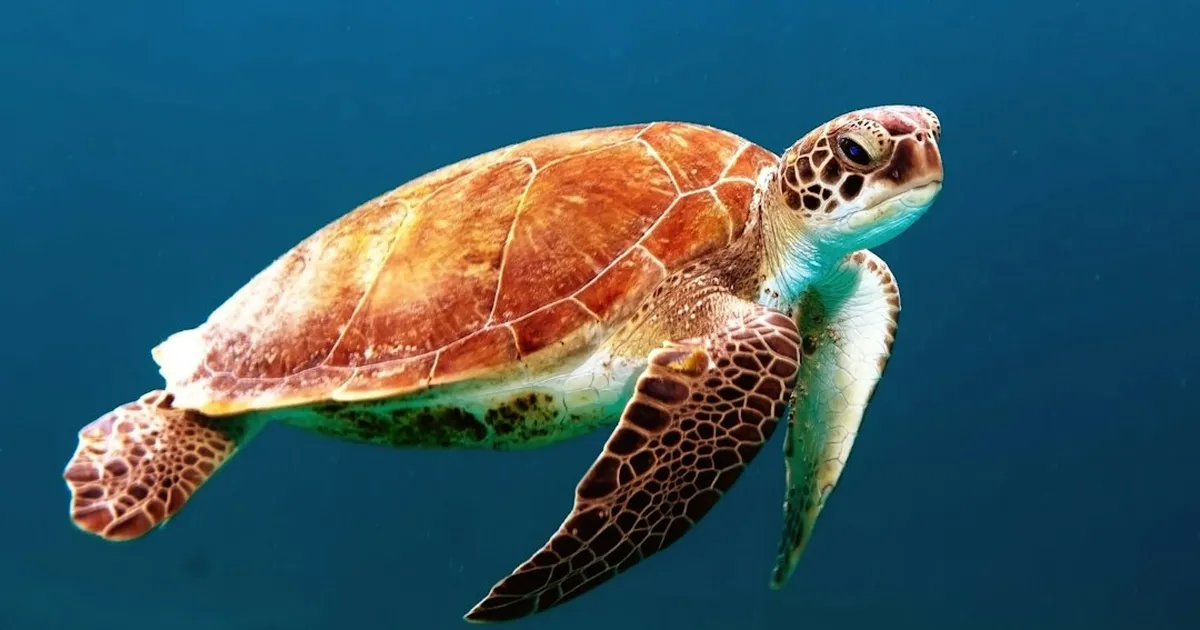
In 1982, the International Union for Conservation of Nature (IUCN) listed the green sea turtle (Chelonia mydas) as endangered. In its latest assessment, published in October 2025 during the IUCN World Conservation Congress in Abu Dhabi, the species now ranks as least concern—not endangered. The global population has grown approximately 28 percent since the 1970s despite persistent threats to individual populations, marking one of the most significant status improvements for a long-lived marine vertebrate on record.
From endangered to least concern
Green sea turtles serve as keystone species in tropical marine ecosystems such as seagrass beds and coral reefs, holding cultural, culinary, spiritual, and recreational significance for people worldwide for millennia. Conservation efforts focused on protecting nesting females and eggs on beaches, expanding community-based initiatives against unsustainable turtle and egg harvesting, limiting trade, and deploying turtle excluder devices on fishing nets to reduce accidental catches. Despite the global improvement, populations remain far below pre-colonial abundance and current harvesting levels in many regions.
Progress masks regional declines
For the first time in 2025, assessors evaluated 11 regional management units (RMUs)—populations defined by genetics, biogeography, tagging data, movement patterns, and expert knowledge—alongside the global assessment. This approach revealed a critical weakness in previous global-only evaluations: severe regional declines can hide behind gains elsewhere. Four of the 11 regional populations remain in decline. The Central-South Pacific population ranks as endangered, the Eastern Pacific and North Indian Ocean as vulnerable. The Central-West Pacific and Mediterranean are listed as near threatened, while populations off Hawaii, in the South Atlantic, the Southwest Indian Ocean, and the East Indian-West Pacific region rank as least concern.
Recovery on Ascension Island, decline in the Eastern Pacific
Protection efforts succeeded notably on Ascension Island and in Brazil, Mexico, and Hawaii, where some populations recovered near pre-commercial exploitation levels. The Eastern Pacific population, listed as vulnerable since 2023, shows a different pattern. Long-term nesting data exist from only two locations—Colola Beach in Mexico's Michoacán state and the Galápagos Islands—which together account for 71 percent of regional nesting. Despite increases at both sites since the 1980s, overall nesting abundance remains approximately 45 percent below 1970s levels. In the North Indian Ocean, where the population was first assessed in 2019 and listed as vulnerable, nesting estimates from Oman and Yemen suggest a 38 percent decline since the 1970s, though data remain limited. The Central-South Pacific faces the steepest challenges, classified as endangered, with fewer than 3,000 breeding females estimated to remain.
Threats persist despite recovery
Bycatch in fishing operations and direct, non-subsistence harvest of turtles and eggs remain leading causes of death. Unsustainable coastal and marine development continues to destroy critical habitat. Climate change poses an intensifying risk, particularly for nesting beaches. The Southwest Pacific population, which includes Raine Island in Australia—the world's largest nesting site—has shown declining hatchling production in recent years, a development the IUCN views as cause for significant concern. The assessment notes that applying IUCN Red List criteria to long-lived, migratory species like sea turtles remains methodologically challenging, particularly when data gaps and complex life cycles make trends difficult to quantify precisely. According to Roderic Mast, co-chair of the IUCN's Marine Turtle Specialist Group, the green turtle's continued global recovery demonstrates what coordinated global conservation can achieve over decades for marine species.