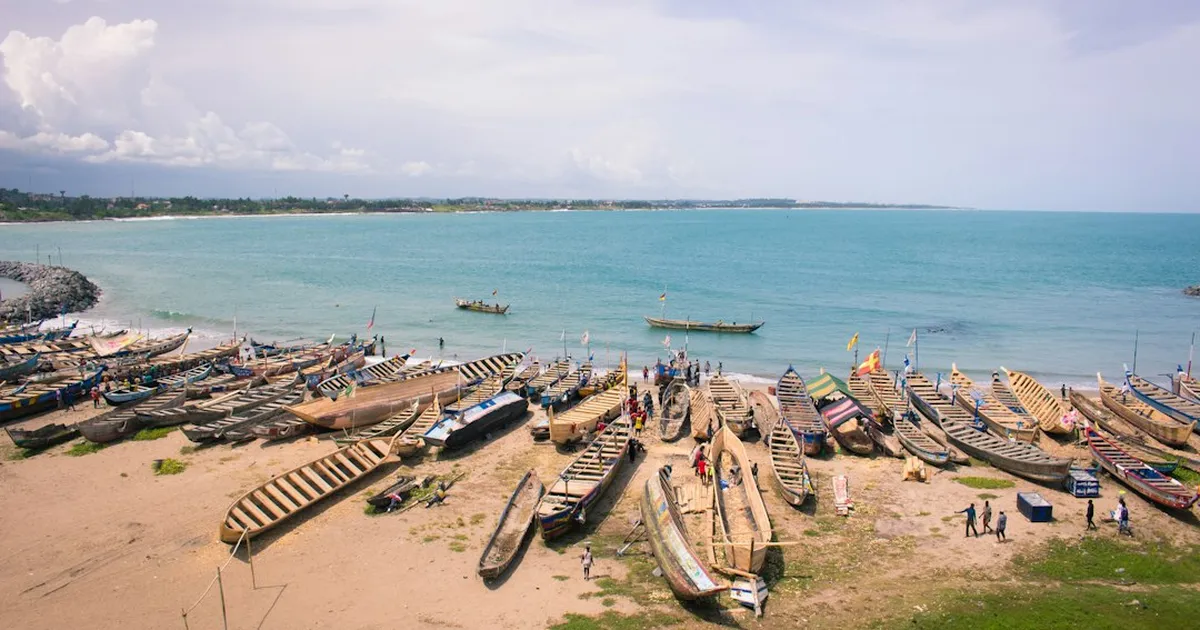
At a ceremony in Busua in the Western Region, Vice President Naana Jane Opoku-Agyemang announced on April 14, 2026, the designation of Greater Cape Three Points as Ghana's first marine protected area. Reports cite different figures for its size: 3News confirmed in October the same 703.86 square kilometres, while the specialist publication SeafoodSource reported 686 square kilometres of water. Opoku-Agyemang said scientific evidence indicated a steady decline in Ghana's fish stocks, with consequences for food security and the coastal economy, and assured the affected communities that the protected area did not mean a complete fishing ban but was intended to rebuild and preserve stocks. Active enforcement of the protection rules had not yet begun by early September, according to Evans K. Arizi, chairman of the technical advisory committee responsible.
Legal basis and background
The legal basis is Section 39 of the Fisheries and Aquaculture Act, 2025 (Act 1146), which prohibits fishing, dredging and the extraction of sand or gravel in a marine fisheries reserve without written permission from the minister. Ghana's cabinet had already approved the establishment of the protected area on October 7, 2025, and instructed the ministry responsible to implement the decision through publication in the official gazette. As of November 10, 2025, Ghana had protected 15 percent of its land and inland waters and designated five Ramsar sites, according to an official case study.
The national fisheries management plan for 2022 to 2026 commits Ghana to establishing at least two marine protected areas by 2026.
What reaches local communities
Steve Trent, chief executive of the Environmental Justice Foundation, called the declaration a pivotal moment for Ghana and said a well-resourced and effectively enforced protected area would help secure the livelihoods and food security of millions of Ghanaians for generations. Arizi himself confirmed how far Ghana was from that enforcement: the area had not yet been divided into zones and enforcement arrangements had not yet been clearly defined, which was why the expected monitoring of compliance had not begun. According to a report from October, residents of coastal communities describe the following pattern: years of consultation meetings had brought few visible changes, officials would come, take down names and concerns, and little would happen afterwards. Local fishers describe what this means in practice: Peter Essel, a fisher from Akwidaa, told the Ghana News Agency that they continued their usual fishing trips despite knowing that parts of the sea had been designated as a protected area. Emmanuel Coffie, a fisher from Busua, said he knew about the protected area and its importance but had seen no patrols, and no one had explained exactly where fishing had to stop. Kofi Cosmos, deputy secretary to Akwidaa's chief fisherman, cited the lack of markers showing the protected area's boundaries at sea as the reason. Arizi considered it premature to identify a risk of the area becoming a protected area on paper only, because work was under way on a viable management plan. In early September, the Fisheries Commission was developing regulations under the ministry responsible, including penalties and sanctions for fishing violations, its regional director for the Western Region, Charles Teye, said.
Plan due by the end of 2026, implementation in 2027
Arizi announced that development of the management plan had begun and was due to be completed by the end of this year so that the plan could be fully implemented in 2027. Asked about sufficient funding and logistics for monitoring, he said Ghana had the prerequisites and could mobilise the necessary resources through planning and cooperation. Without adequate enforcement, the specialist publication Ocean Economist warns, marine protected areas can become protected areas on paper only that fail to achieve the intended ecological recovery. In the publication's assessment, success depends on institutional capacity, funding and the sustained commitment of the stakeholders involved.