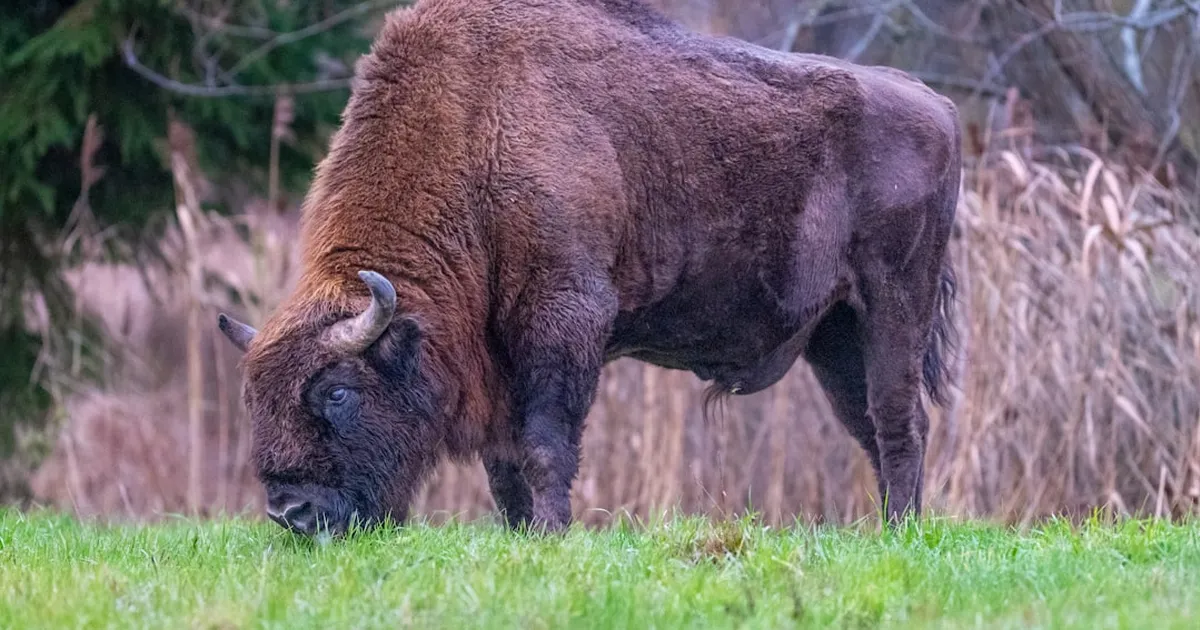
A century ago the European bison was considered extinct in the wild. The last free-living animal was shot in Poland in 1927. What followed is one of the most remarkable recovery stories in conservation history. Starting with fewer than 60 animals in zoos, a breeding programme has produced almost 10,000 free-living European bison across the continent today.
From Extinction to Reversal
At the end of 2024, the European bison population counted 9,762 free-living individuals, according to data from the rewilding organization IUCN. Ten years earlier, the figure was around 2,500. This tripling is the result of decades of coordinated conservation programmes in more than seven countries. Poland, Belarus, Lithuania, Romania, Germany, Switzerland and Bulgaria all host herds of their own today.
In December 2020 the International Union for Conservation of Nature responded to this development and downgraded the European bison on its Red List from "Vulnerable" to "Near Threatened". That is not an all-clear, but it is a clear signal that the trend has reversed.
The success shows particularly clearly in Romania. In the Southern Carpathians, in the Tarcau mountains, a herd has grown to more than 100 animals. A group has lived again in the Bulgarian Rhodope mountains since 2019. In Germany, bison are being reintroduced in several projects, including the Rothaar mountains in the Sauerland region, where Western Europe's first free-living herd was established.
An Unexpected Contribution to Climate Protection
What surprises many: bison are not only a symbol of species protection, they are also climate protectors. A 2024 study in the Journal of Geophysical Research: Biogeosciences by researchers at Yale University examined the Romanian herd in the Tarcau mountains. The result: 170 bison, through their grazing and their modification of vegetation, can store enough carbon in the soil to offset the annual emissions of 43,000 to 84,000 passenger cars.
The mechanism is the so-called ecosystem-engineer effect. Bison feed selectively, trample soil and deadwood, and create fine-scale structures that provide habitat for many species while promoting carbon storage in the soil. Where bison graze, more species-rich forests emerge.
Conservation as Economic Factor
The return of bison attracts people. In Poland and Romania, bison watching has spawned notable ecotourism. Travel agencies offer specialized tours and local communities profit. This also changes social acceptance of wildlife in cultural landscapes. Where animals generate income, the pressure from illegal hunting tends to fall.
Not all developments run smoothly. Farmers in some regions report damage to fields and grazing fences. Conservation organizations and local authorities are working on compensation schemes to defuse such conflicts.
What Comes Next
The goal of European conservation programmes is a stable total population of at least 5,000 genetically diverse animals in the wild, distributed across as many independent herds as possible. That goal is now considered reached, yet the work continues. Genetically isolated populations must be connected through targeted translocations to avoid inbreeding. In several countries, including France and Slovakia, feasibility studies are underway for additional reintroductions.