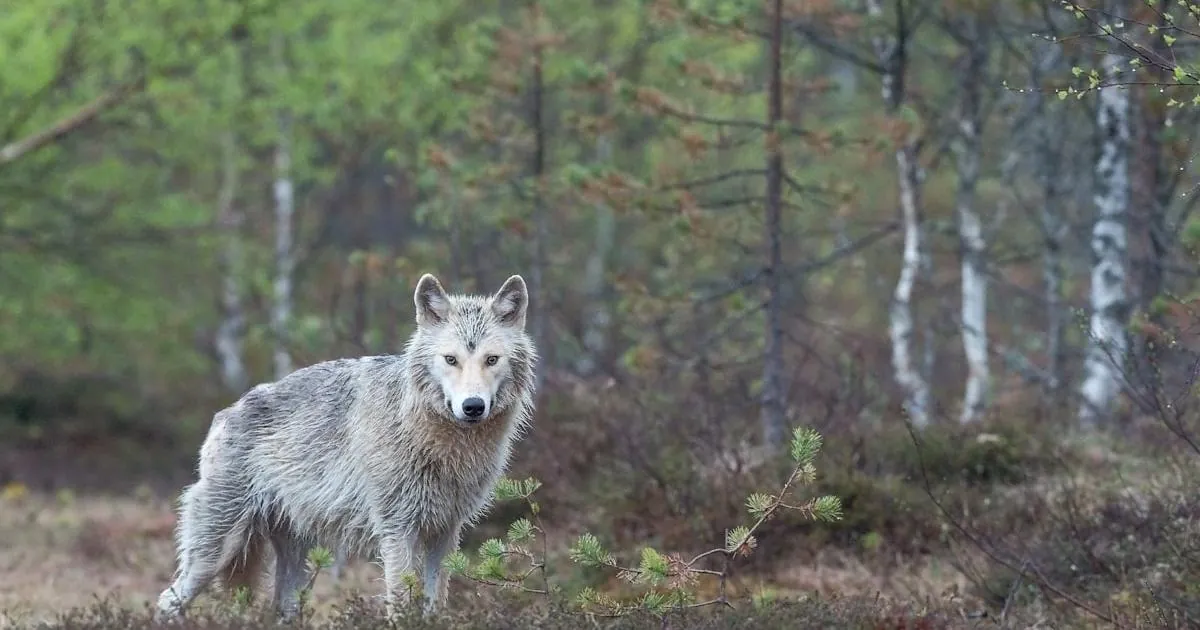
In the second half of the twentieth century the wolf was considered extirpated across large parts of Europe. Several countries had no free-living wolves for decades. Today an international scientific study counts 21,500 animals in 34 European countries, 58 percent more than ten years ago. The recovery is one of the most remarkable conservation stories of recent history, and it has opened a political debate that shows how complex conservation successes can be.
What the Study Measures
Cecilia Di Bernardi and Guillaume Chapron of the Swedish University of Agricultural Sciences, together with roughly 40 European scientists, analyzed wolf populations. The study appeared on 25 February 2025 in the journal PLOS Sustainability and Transformation and covers data from 34 countries. The headline number: 21,500 wolves live in Europe today, roughly 19,000 of them within the European Union.
In 19 of 34 surveyed countries the population grew, in eight it was stable and in only three declining. Seven countries now count more than 1,000 animals: Bulgaria, Greece, Germany, Italy, Poland, Spain and Romania. Adult wolf survival across Europe averages 88 percent per year, and 75 percent for young animals. Both figures point to well-established, stable populations.
From Single Packs to Hundreds
The numbers for individual countries are striking. Germany had no wolves for more than a century; the first pack returned around the year 2000 to Saxony. The Federal Agency for Nature Conservation today confirms 128 packs, 35 pairs and 10 solitary animals. That corresponds to a doubling of the pack count within a few years.
Other large predators are also returning. The lynx is present again in Germany, with at least 194 animals, most in Bavaria. In some regions of Brandenburg and Saxony, predator density has grown high enough to create its own political dynamic.
Success and Its Conflicts
The recovery has a flip side, one the study explicitly names. Wolves kill roughly 56,000 livestock animals across the EU each year. Compensation costs amount to about 17 million euros annually. In Germany, this led to a political consequence in March 2026: parliament passed a law that, under defined conditions, allows regulated wolf hunting. The law was the direct result of pressure from grazing regions, where sheep and cattle farmers have reported significant losses for years.
The study authors do not see this as a defeat for conservation but as a necessary adaptation. Sustainable coexistence between humans and wolves requires active political management. Countries such as Switzerland and Norway have already gathered experience combining regulatory intervention with protection programmes.
Why Europe Is an Exception
The European success story is not a global standard. Around the world, large predator populations are under pressure. Europe's recovery has two structural reasons. First, the EU's Habitats Directive provides a binding legal framework that limits national solo actions. Second, rural population density in parts of southeastern Europe has declined in recent decades, opening up new habitat.
What the 2027 Data Will Show
A follow-up study is planned for 2027 and should deliver updated population figures. The new regulation frameworks enter into force in 2026. Their effect on populations will likely appear first in the 2028 data. For conservation organizations, any legalized hunting is a step backward. For sheep farmers it is a long overdue response to real losses. This tension will shape the wolf debate in Europe for years to come.