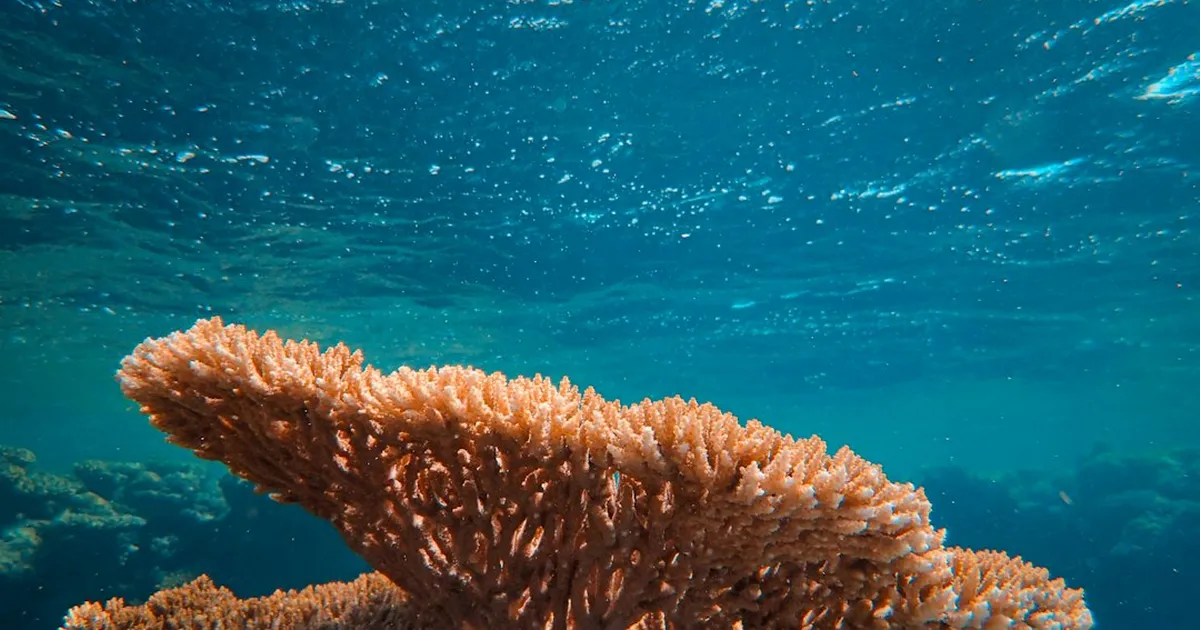
Heat stress can sever the symbiosis between corals and their photosynthetic algal symbionts, triggering a expulsion that starves the coral and leaves it vulnerable to algal overgrowth. Recovery typically takes months or longer. A study published October 14 in Science Advances describes what Stanford researchers say is the fastest documented reversal of coral bleaching.
How the contact experiment worked
Researcher Danny Collins paired ten bleached and healthy coral fragments of the same genetic clone. Five pairs were placed in direct contact, five were separated by millimeters. Bleached corals in the control group without contact remained white for weeks before algal overgrowth killed them. In contact pairs, tissues fused to form a bridge across which symbiotic algae migrated from healthy to bleached coral. Under the microscope, researchers detected algae in polyp tissues by day three.
All corals with at least one week of contact, plus one coral with only five days of contact, achieved full polyp recovery within 7 weeks. Researchers tested contact durations ranging from one day to three weeks. Genetic identity was essential. When researchers paired corals of different genotypes, they observed antagonistic reactions within hours that prevented symbiont transfer.
Why scaling is impossible with current biology
Each bleached coral would require a genetically identical, healthy partner for recovery, making the technique impractical for reef restoration at scale. Genetic differences triggered immune-like rejection. Researchers acknowledged limitations: laboratory corals received more nutrition than reef populations, tests covered only one species and two genotypes, and the contact advantage was not tested on full-sized colonies facing real ocean temperatures.
Global context: coral losses accelerate
The world's reefs lost nearly 10 percent of living coral cover over four decades, according to the Global Coral Reef Monitoring Network's latest assessment. Between 2023 and 2024 alone, cover dropped by nearly 9 percent during a global bleaching event. Between January 2023 and September 2025, approximately 84.4 percent of reefs experienced heat stress sufficient to cause bleaching. Mass bleaching events now occur every five to six years, leaving reefs less recovery time between heat pulses. Natural recolonization by drifting algae often moves too slowly to prevent reef death.
Next steps and caveats
Study co-author Fiorenza Micheli said the finding could inspire larger-scale solutions. Co-author Steve Palumbi cautioned that supporting recovery does not shield corals from continued temperature rise. The team plans to investigate whether symbiotic algae can be harvested from healthy corals before heat waves, then transferred in bulk to bleached corals without requiring sustained contact. For now, the work shows that individual coral fragments can achieve complete recovery in eight weeks under controlled conditions, not whether that translates to entire reef systems.