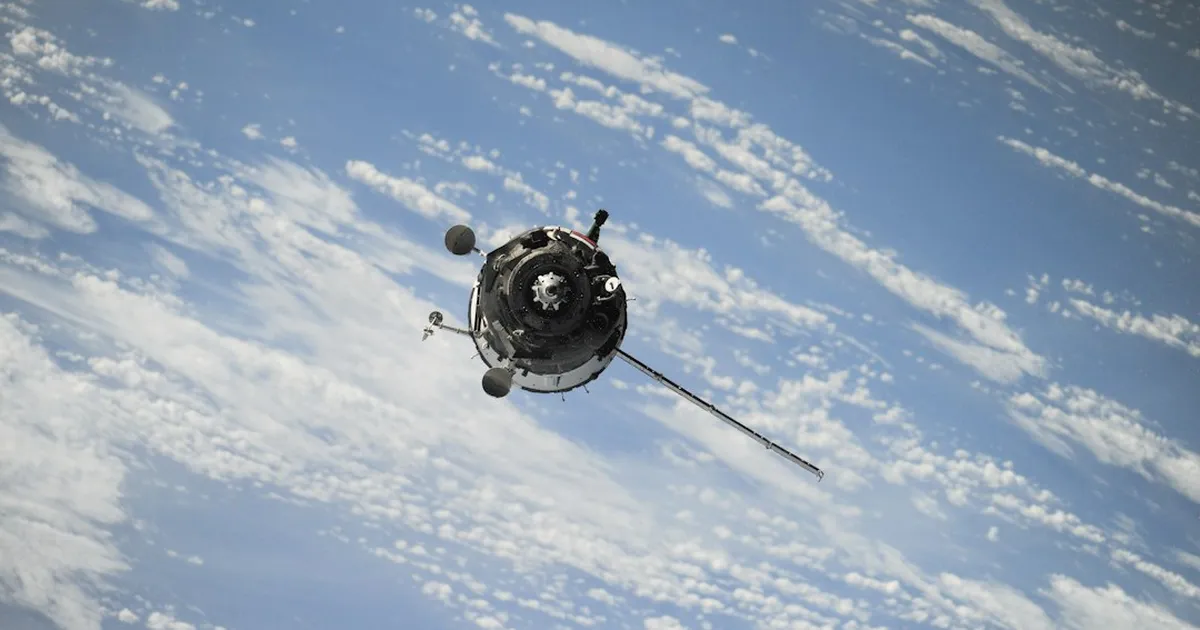
Before entering Mercury orbit, the mission control team at the European Space Agency ESA is due to fine-tune the trajectory of the spacecraft composite, made up of MPO and Mio, using the MPO's chemical propulsion system. The European orbiter MPO is due to separate from the Japanese orbiter Mio on December 9 and 10, 2026, with Mio due to reach its final elliptical polar orbit during the separation; the science phase for both probes is due to begin on April 6, 2027. During orbital insertion, according to an ESA animation, four MPO thrusters are to slow the spacecraft composite, still connected to Mio, as it approaches Mercury's south pole; an elliptical orbit of 590 by 11,640 kilometres is initially planned.
Eight years, a power fault, a one-year delay
The probe launched in October 2018 on an Ariane 5 rocket from French Guiana, as Space.com reported. The planned trajectory included one flyby of Earth, two of Venus and six of Mercury over roughly seven years. The journey was extended by a year after a problem with the solar panels reduced the power available to the transfer module's electric thrusters. According to ISAS, ESA reported in May 2024 a fault in the power supply system of the transfer module that prevented the ion thruster from operating at maximum power. The remaining thrust would not have been sufficient for entry into Mercury orbit originally planned for December 2025, so a new trajectory was chosen. According to JAXA, the delay was not expected to affect the operation of the two orbiters; both were to conduct their scientific observations as originally planned.
On June 15, 2026, the transfer module's solar electric propulsion system was switched off, ending its main mission. On September 3, 2026, at 15:49 Central European Summer Time, the mission control team received the signal that the transfer module had successfully separated from the spacecraft composite, the first step in the arrival at Mercury. After that, according to ESA, the probe was still more than three million kilometres from Mercury; the arrival is considered a six-month sequence of manoeuvres overall. The transfer module, now non-operational and equipped with neither its own antenna nor an onboard computer, remains in a stable orbit around the Sun, according to ESA.
For comparison: MESSENGER was the first probe to orbit Mercury
Before BepiColombo, one probe had already orbited Mercury: the NASA mission MESSENGER. MESSENGER remained in orbit for more than four years, determined the composition of Mercury's surface, revealed its geological history and showed that its polar deposits consist predominantly of water ice. The mission ended on April 30, 2015, when MESSENGER struck Mercury's surface at roughly 14,080 kilometres per hour, leaving a new crater.
Following the planned separation of MPO and Mio on December 9 to 10, 2026, BepiColombo is set to become the first mission to fly two spacecraft around Mercury at the same time, according to ESA. While MESSENGER primarily studied the planet's geology, magnetic field and chemical composition, BepiColombo is to study the interaction of Mercury's magnetosphere with the solar wind, its internal structure with its large iron core, and the origin of its magnetic field. The mission is also to test Einstein's general theory of relativity with highly precise measurements of the orbit and provide new pieces for reconstructing Mercury's early history, according to the Spanish newspaper El País, without being able on its own to prove that the planet once suffered a massive impact, according to scientists cited by the newspaper.
What the announcement does not yet show
The sources reviewed confirm the announced date of November 21 and the ESA animation published for it. According to El País, the probe must remain aligned within narrow limits: too great a deviation from the ideal position would interrupt the power supply, while pointing too far towards the Sun would damage the instruments. According to industry publication TS2, ESA describes the orbital insertion programme as a sequence of 16 thruster firings through March 2027; during earlier exercises, controllers also rehearsed a simulated fault that forced them to abort and replan a separation. ESA itself points out that the exact dates may still change for operational reasons.
From Guiana in 2018 to science in 2027: Eight years in dates
Launch in October 2018, separation of the transfer module on September 3, 2026, planned entry into Mercury orbit on November 21, 2026, planned separation of MPO and Mio on December 9 to 10, 2026, and planned start of the science phase on April 6, 2027: this is how ESA and Space.com describe BepiColombo's schedule. MPO is to carry out several more thruster firings to reach its final scientific orbit by March 2027.